Welding vs Bolt on

/ Welding vs Bolt on #1  

p0peye

Bronze Member
Joined
Jun 18, 2010
Messages
51
Location
southern tier Ny
Tractor
JD 2520
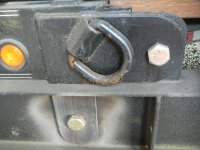
Which would be stronger the welded on trailer D-rings if weld is about 1'' on each side of bracket vs bolt on D-rings with 2 bolts 1/2'' grade 8 course thread or would they be about the same? Does the welded one become part of the trailer and not a weak point?
 
/ Welding vs Bolt on #2  
Welded will be much stronger provided the welds are quality. If you're doing it as a DIY project, you may want to do the bolt-on method as it's more DIY friendly.
 
/ Welding vs Bolt on #3  
How thick is the material you'll be welding to/drilling thru?
 
/ Welding vs Bolt on #4  
How thick is the material you'll be welding to/drilling thru?

Very relevant for understanding what sort of Working Load Limit the mounted ring will have when done. Does this play in when considering whether to weld or bolt on?
 
/ Welding vs Bolt on #5  
Majority of the time I weld them on, but will bolt if I don't want to screw up the paint.
 

Attachments

  • D ring1.JPG
    D ring1.JPG
    235.9 KB · Views: 1,150
  • Bolts capability.jpg
    Bolts capability.jpg
    100.7 KB · Views: 3,201
/ Welding vs Bolt on #7  
You can always do both. Seen it done plenty of times.
 
/ Welding vs Bolt on #8  
Majority of the time I weld them on, but will bolt if I don't want to screw up the paint.

"Paint"... Good item to focus on... Paintend metal can be ground, cleaned, welded to, and repainted. Powder-coated is a bit different as you can't do a "touch up" on powder coating. You can either strip the whole thing and re-coat, or you can cover the bare metal with paint and deal with it looking a little different.
 
/ Welding vs Bolt on #9  
Material thickness does enter into the decision. If there's sufficiently thick material, the bolts will have enough bearing area that they don't yield the sides of the hole. Good bolted joint design would also suggest that the part of the bolt that bears against the hole is a smooth shank; not threads. Other good design practices: as smooth a hole bore as you can manage - reamed, if you can. Also, hole size just a tad bigger than the bolt shank will reduce bearing stresses, too. And don't forget to put thick, flat washers between the nut and the hole! I have hooks bolted to my FEL and they have handled some good sized loads - I've maxed the 724kg loader lifting logs with them. I never apply a jerked load to them - at least not intentionally. They rely on static friction of the clamped joint to stay put up until the point they start to slide, then dynamic friction takes over, and it's much less helpful. Before you know it the clearance between the bolt and hole have disappeared and now the bolt and the metal on the sides of the hole start loading in shear and compression. That's when a smooth hole, smooth bolt shank and large contact area keep everything from going "DOINK".
 
/ Welding vs Bolt on #10  
Yes I should have specified powder coating. I have two PJ trailers, both powder coated. I'm totally convinced Ray Charles did the coating.:laughing:
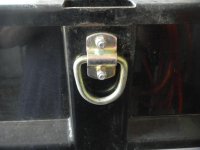
Here is a bolted D-ring on my dump trailer.
 

Attachments

  • Padeye bolt.JPG
    Padeye bolt.JPG
    240.8 KB · Views: 466
/ Welding vs Bolt on #11  
Yes I should have specified powder coating. I have two PJ trailers, both powder coated. I'm totally convinced Ray Charles did the coating.:laughing:
Here is a bolted D-ring on my dump trailer.

He interned under Stevie Wonder before getting his license... ;)

Your pic raises another question... I would expect, especially giving consideration to Baby Grand's comments on "process", that the bolt head should be against the D-Ring plate and not the nut end of the assembly. How much difference in bearing capability could this make?
 
/ Welding vs Bolt on #12  
How much difference in bearing capability could this make?
No difference at all in my opinion.
I placed the bolts inside the stake pocket, I figured it was easier than trying to thread the nut on the bolt, with the nut on the inside of the stake pocket. I used fender washers on the heads of the bolts, because the stake pocket material is really thin.
 
/ Welding vs Bolt on #13  
I wouldn't expect a difference, either. But, Baby Grand made a point about reaming the hole (so it was smooth) and placing a smooth shank bolt instead of threads where it passes through the hole... So, I'm wondering how much load bearing ability one loses because of having threads that can come in contact with the edges of the bored hole.
 
/ Welding vs Bolt on #14  
In certain application I can see where that is very important! I thought we were talking about bolting or welding D-rings, that were most likely made off shore. Now if we were using A-325 bolts on a high rise, OK then I understand. ;)
 
/ Welding vs Bolt on #15  
Agreed... Understanding the exact application, and the exact materials in use could change how "picky" one needs to be about the process. Generally, grade 8 bolts to attach D-Rings should give the desired result, I would think.
 
/ Welding vs Bolt on #17  
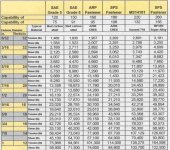
with two 1/2" gr8 bolts having a tensil capacity of ~45k lbs and a shear of 35k lbs and welds being just as strong (if done right) or stronger, Me thinks other things will bend/break before the attachment method of choice.
 
/ Welding vs Bolt on #18  
with two 1/2" gr8 bolts having a tensil capacity of ~45k lbs and a shear of 35k lbs and welds being just as strong (if done right) or stronger, Me thinks other things will bend/break before the attachment method of choice.

That was the point I was trying to make before I got all sidetracked on design - for the loads that an FEL would see, a bolted joint should be just fine.
 
/ Welding vs Bolt on #19  
No difference at all in my opinion.
I placed the bolts inside the stake pocket, I figured it was easier than trying to thread the nut on the bolt, with the nut on the inside of the stake pocket. I used fender washers on the heads of the bolts, because the stake pocket material is really thin.

Sounds right. Having them the other way around would help if it was loaded to the point that everything starts deforming and the flange starts prying the nut from one side, but that shouldn't ever be an issue in this application. In this case, which ever arrangement lets you torque the nut more carefully is probably best.
 
/ Welding vs Bolt on #20  
Just one additional note:
The only reason that I bolted the hooks onto my FEL and didn't weld them on was that I didn't have any welding equipment at the time, couldn't move my tractor to someone who did, and didn't want to pay for a weldor to come here for such a trivial job.
-Jim
 

Marketplace Items

Location Info Please
2021 JOHN DEERE 6145R TRACTOR (A59823)
2021 JOHN DEERE...
2024 Case IH Farmall 75A (A60462)
2024 Case IH...
Cat CB24B (A60462)
Cat CB24B (A60462)
Eagle Weathervane (A55853)
Eagle Weathervane...
10 Lug Wheels Full Set (A57453)
10 Lug Wheels Full...
 
Top