weight of concrete

   / weight of concrete #1  

Chain Bender

Silver Member
Joined
Feb 25, 2011
Messages
244
Tractor
Kubota L3200
Today I made a balast weight for my L3200. I used 7 1/2 80# bags of ready to use concrete mix. I figure I added about 2+ gallons of water to each bag.

NOW......here's the question. How much weight will a gallon of water add to the concrete when it has dried. I know some of the water will evaporate through the top while it is drying, but the mix is in a plastic drum.

As I mixed each bag of concrete mix and poured it in the barrel I also threw in some busted up chunks of a slab made out of the exact same mix. I estimate I threw in about 100# of the chunks. I also think the internal welded frame and the barrel weighed about 40-50#'s.

I think the barrel will weigh in some where between 700 and 750 pounds. I have a 27" piece of 3/4" cold rolled round stock for lift pins. If I keep the lift arms pulled/pushed against the barrel as close as I can, will the 3/4" pins be strong enough? I know it's a little late to ask now, but I've been thinking about it since the minute I walked away from the barrel this afternoon.

thanks for your time.

CB
 
   / weight of concrete #2  
Cured concrete weighs about 145 pounds per cubic foot. My gut feeling is the 3/4" stock should be plenty strong enough if done correctly, but that is just my opinion.

Rich
 
   / weight of concrete #3  
Well I dont know about the 3/4 cold rolled, probably be ok, but I used a commercial drawbar from TSC. of course it is 7/8 on the pins. It was 26 dollars. Now as to the water , almost all of the weight stays in the form of hydrates locked into the concrete matrix.

James K0UA
 
   / weight of concrete #4  
Well, lets calculate the load the pins can take....

Pin material say has a yield stress of 18,000 psi, ultimate stress 36,000 psi.

Area = Pi * Radius squared

Area Pin = 3.1412 * .375 squared

Area Pin = .442 inches squared

.442 inches squared * 18,000 psi = 7956 lb

Each pin can withstand 7956 lb with a safety factor of about 2. So that means that (2) pins can hold 15,912 lb with a safety factor of 2.

Needless to say, I bet your tractor doesnt weigh that much......

Edit: Tractor weight (4WD Hydro) = 2623 lb

You are fine!!

Craig
 
Last edited:
   / weight of concrete
  • Thread Starter
#5  
Well, lets calculate the load the pins can take....

Pin material say has a yield stress of 18,000 psi, ultimate stress 36,000 psi.

Area = Pi * Radius squared

Area Pin = 3.1412 * .375 squared

Area Pin = .442 inches squared

.442 inches squared * 18,000 psi = 7956 lb

Each pin can withstand 7956 lb with a safety factor of about 2. So that means that (2) pins can hold 15,912 lb with a safety factor of 2.

Needless to say, I bet your tractor doesnt weigh that much......

Edit: Tractor weight (4WD Hydro) = 2623 lb

You are fine!!

Craig

XXXXXXXXXXXXXXXX

Tractor also has an LA524 on it.

The internal frame is 2X2X.250". Inside of the 2X2 cross bar or draw bar I put a full length (side to side) piece of 1" EMT and the cold roll runs through it. I think with a 3/4" bar 27" long I'll have about 3.5" of pin sticking out of the barrel. With a clinch pin hole at about 3/8" from the end of each end. SO, my lift arms have about 1.5" of ball width. That will make the usable length of the pins about 3". I have kept rolling the 3/4" bar so it won't stick to the concrete. It is very possible that if the 3/4" bends I can cut it off at the barrel and punch it out either side and replace it with a 7/8" piece. Hopefully that won't be necessary. (fingers crossed)

CB
 
   / weight of concrete #6  
Well, lets calculate the load the pins can take....

Pin material say has a yield stress of 18,000 psi, ultimate stress 36,000 psi.

Area = Pi * Radius squared

Area Pin = 3.1412 * .375 squared

Area Pin = .442 inches squared

.442 inches squared * 18,000 psi = 7956 lb

Each pin can withstand 7956 lb with a safety factor of about 2. So that means that (2) pins can hold 15,912 lb with a safety factor of 2.

Needless to say, I bet your tractor doesnt weigh that much......

Edit: Tractor weight (4WD Hydro) = 2623 lb

You are fine!!

Craig

I know this is splitting hairs, but since the top of the pin is in compression and the bottom is in tension, wouldn't the maximum load be less than that? You're only assuming axial loading right?

I always thought it would be best to treat the pins as if they were loaded in shear. Correct me if I'm wrong here, but my understanding of the process is to find the shear stress at the neutral axis, where it will be greatest in the part and use that as the limiting factor for the load.

The formula for the maximum shear stress in a solid cylinder is:
s = (4F)/(3*pi*R^2).

Rearranging to find the force, the equation now becomes:
F = (3/4)*pi*R^2*s

F = (3/4)*3.14159*0.375^2*18000 = 5677.8 lb per pin
 
Last edited:
   / weight of concrete #7  
Today I made a balast weight for my L3200. I used 7 1/2 80# bags of ready to use concrete mix. I figure I added about 2+ gallons of water to each bag.

NOW......here's the question. How much weight will a gallon of water add to the concrete when it has dried. I know some of the water will evaporate through the top while it is drying, but the mix is in a plastic drum.

thanks for your time.

CB

The answer is almost exactly what the water weighs, 8.3 pounds per gallon.
It a crazy thing called hydration that turns water into a solid form. Goes against what we imagine happens to water to all other scenarios.
The water is chemically converted to a solid and stays there forever :confused2:

I tried to find a simple link that could explain it but couldn't.
It's complicated, I've worked with masonry all my life and I always thought the water just evaporated, till I learned about hydration.

JB.
 
   / weight of concrete #8  
The bottom line I think is that it weighs what the inputs weighed. Unless too much water was used, then some will evaporate. But not much.

The water chemically bonds with tricalcium silicate in the portland cement. In this chemical reaction both the inputs are changed and you are left with a different compound. While some water may be left this would be due to hydration being complete for all the available portland cement. It is a specific ratio of water to cement.

That water is not a solid form of water but the new compound is solid.

The equation for the hydration of tricalcium silicate is given by:

Tricalcium silicate + Water--->Calcium silicate hydrate+Calcium hydroxide + heat

2 Ca3SiO5 + 7 H2O ---> 3 CaO.2SiO2.4H2O + 3 Ca(OH)2 + 173.6kJ

Here's a link:

Concrete: Scientific Principles
 
   / weight of concrete #9  
Today I made a balast weight for my L3200. I used 7 1/2 80# bags of ready to use concrete mix. I figure I added about 2+ gallons of water to each bag.

NOW......here's the question. How much weight will a gallon of water add to the concrete when it has dried. I know some of the water will evaporate through the top while it is drying, but the mix is in a plastic drum.

As I mixed each bag of concrete mix and poured it in the barrel I also threw in some busted up chunks of a slab made out of the exact same mix. I estimate I threw in about 100# of the chunks. I also think the internal welded frame and the barrel weighed about 40-50#'s.

I think the barrel will weigh in some where between 700 and 750 pounds. I have a 27" piece of 3/4" cold rolled round stock for lift pins. If I keep the lift arms pulled/pushed against the barrel as close as I can, will the 3/4" pins be strong enough? I know it's a little late to ask now, but I've been thinking about it since the minute I walked away from the barrel this afternoon.

thanks for your time.

CB

I used virtually the same amount of material in my rain barrel / balast. I used 3/4" threaded rod, and haven't broken or bent it yet. It's actually a little on the light side because the barrel sits tight in between the wheels, and has little mechanical advantage. It is nice and compact though, and I use the open area above the concrete as a chain and tool carry all. This is on a CT235.
 
   / weight of concrete
  • Thread Starter
#10  
I used virtually the same amount of material in my rain barrel / balast. I used 3/4" threaded rod, and haven't broken or bent it yet. It's actually a little on the light side because the barrel sits tight in between the wheels, and has little mechanical advantage. It is nice and compact though, and I use the open area above the concrete as a chain and tool carry all. This is on a CT235.


I left about 8-10 gallons out of the 190 litre barrel for the same thing. I'll try to take some pictures tomorrow and post them.

So an 80 pound bag of readi-mix, mixed, should weigh 100# +/- a few when dried. How many cubic feet does a gallon of liquid take up?

thanks to all.....
CB
 
   / weight of concrete #11  
I left about 8-10 gallons out of the 190 litre barrel for the same thing. I'll try to take some pictures tomorrow and post them.

So an 80 pound bag of readi-mix, mixed, should weigh 100# +/- a few when dried. How many cubic feet does a gallon of liquid take up?

thanks to all.....
CB


7.5 gallons per cubic foot, so 1/7.5 = 0.13 cubic feet per gallon.

JB
 
   / weight of concrete #12  
I left about 8-10 gallons out of the 190 litre barrel for the same thing. I'll try to take some pictures tomorrow and post them.

So an 80 pound bag of readi-mix, mixed, should weigh 100# +/- a few when dried. How many cubic feet does a gallon of liquid take up?

thanks to all.....
CB

A gallon of water (or whatever) is 231 CI or about .1336 CF
 
   / weight of concrete #13  
i'm basing these rough numbers on the aisc 9th edition (it was already on the desk & i didn't want to go find a newer manual) published in 1989.

page 4-5, allowable shear load:

Fv = 0.22(Fu)(A), where Fv is the shear strength of the rod and Fu is the ultimate tensile strength of the base metal, and A is the area of the bar.

if it is cold rolled a1018, then the ultimate strength is 63.8 ksi. if it is hot rolled a36, then the ultimate strength is likely 58 ksi. i only add the "ifs" because in my experience most steel is hot rolled. you can often buy cold rolled at local hardware and home centers, but most steel supply centers that sell angles, plates, channels etc will be selling hot rolled unless you specify otherwise.

Fv = 0.22(63.8ksi)(0.4418 in^2) = 6.2 k = 6,200 lb per pin for a1018 cold rolled.

those numbers, and any other calculated ones are for statically loaded conditions, meaning pinned together and not moved afterward. we all know that tractors bounce around so you can guarantee that there will be some extra forces from impact loading, and also some bending forces if the lift arms are not tight to the weight block.
 
   / weight of concrete
  • Thread Starter
#14  
i

if it is cold rolled a1018, then the ultimate strength is 63.8 ksi. if it is hot rolled a36, then the ultimate strength is likely 58 ksi. i only add the "ifs" because in my experience most steel is hot rolled. you can often buy cold rolled at local hardware and home centers, but most steel supply centers that sell angles, plates, channels etc will be selling hot rolled unless you specify otherwise.

Fv = 0.22(63.8ksi)(0.4418 in^2) = 6.2 k = 6,200 lb per pin for a1018 cold rolled.

those numbers, and any other calculated ones are for statically loaded conditions, meaning pinned together and not moved afterward. we all know that tractors bounce around so you can guarantee that there will be some extra forces from impact loading, and also some bending forces if the lift arms are not tight to the weight block.


XXXXXXXXXXX

It is cold rolled. I asked for standard 3/4" round stock but they were out. I live 45 miles from the steel shed so I went ahead and paid the $34 I think it was so I wouldn't have to go back later and could get on with the project. I also had plans for the remainder of the 10' stick.


I'm thinking it is going to be closer to 800# than 700# since I got the numbers to calulate with. How long should I let a 50 gallon barrel with 42 gallons of concrete dry? The temps have been any where from 30 to 60 yesterday and today and probably the same for teh next several days. I'd hate to go through all the trouble of making the thing and fracture it trying to get it out from under the barn.

Thanks for the input.

CB
 
Last edited:
   / weight of concrete #15  
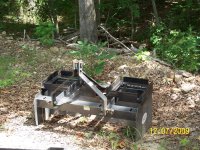
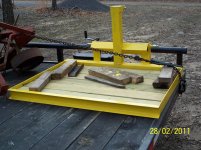
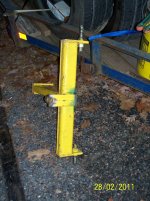
Since my Kubota cannot put down force on my 3 point I wanted weight on my Box Blade. I used some 3x2x3/16 Angle I had on hand and framed for 16x16x4 Concrete Cap Blocks on each side . 2 Blocks are @ 175# if I remember right. Four blocks seemed a bit much tho the Bota did not have a problem. 100_0173-1.jpg

100_0305.jpg

Trlr Mover.jpg

3 Pt Hauler, Box Blade & Trlr Toter could have been made reversible w/ GN Ball on top & also with a socket on bottom to use different Hitch Inserts. :cool:
 
   / weight of concrete #16  
Today I made a balast weight for my L3200. I used 7 1/2 80# bags of ready to use concrete mix. I figure I added about 2+ gallons of water to each bag.

NOW......here's the question. How much weight will a gallon of water add to the concrete when it has dried.
CB

I had the same question regarding an 80 lb. bag of Sakrete Concrete mix. I sent them an email and they replied 88 lbs. Real close what JB4310 said too.
 
   / weight of concrete #18  
Total weight will probabally be ~900lbs

Cured concrete weighs 150lb/cuft

80lb bags are typically 2/3 cu/ft

So you have with 7.5bags, you have 5 cu-ft

So that is 750 of concrete +~100lbs of chunks, + barrel + steel =~900lbs.

Hard to narrow down anymore and it is really pointless. What you have is enough weight for ballast and well within the lift cap.

As to the pins, they are just fine. Personally, I would have used the 7/8". But not for strength, but because they will fit tighter and wouldnt wear out the ball ends as quick due to the slop.

But look at all the heavy cat 1 3PH implements that see WAY more than 900lbs force and only have 7/8" pins. Like plows, rear blades, or any ground engaging implement. Those can easially see 2500lbs+ because you tractor can generate a LOT of tractive force.

So there ya go. Pins are fine, and about 900lbs
 
   / weight of concrete #19  
I would give the concrete at least 7 days to cure before moving it around. At 30F the hydration slows to almost nothing with just the heat of hydration to keep it from freezing. When above 40F, concrete will reach 70-80% of its strength in 7 days. 28 days cure @70F with concrete sample in a water bath is what is used to test concrete for compressive strength to verify that it will meet the design requirements. This gives the optimum conditions and field poured concrete may not be of the same strength. The warmer you can keep it, the better it will cure.
 
   / weight of concrete
  • Thread Starter
#20  
I would give the concrete at least 7 days to cure before moving it around. At 30F the hydration slows to almost nothing with just the heat of hydration to keep it from freezing. When above 40F, concrete will reach 70-80% of its strength in 7 days. 28 days cure @70F with concrete sample in a water bath is what is used to test concrete for compressive strength to verify that it will meet the design requirements. This gives the optimum conditions and field poured concrete may not be of the same strength. The warmer you can keep it, the better it will cure.

I had to move it at the 3 day mark. It was just in my way. I didn't plan well ahead. My shop floor was the only place I had that was flat and the barrel wouldn't get rained in. I lifted genly and didn't bump it at all when I set it down. Need to finsh up the 3/4" lift pins/rod today and get it ready for log work.

Thanks again to all who have had informative input.
CB
 

Tractor & Equipment Auctions

500 BBL FRAC TANK (A58214)
500 BBL FRAC TANK...
LIMA MAC 30KW GENERATOR (A58214)
LIMA MAC 30KW...
2020 INTERNATIONAL MV607 26FT NON CDL BOX TRUCK (A59575)
2020 INTERNATIONAL...
Year: 2014 Make: Chevrolet Model: Silverado Vehicle Type: Pickup Truck Mileage: Plate: Body Type: 4 (A55852)
Year: 2014 Make...
1752 (A60430)
1752 (A60430)
(INOP) 2007 VOLVO A35D OFF ROAD DUMP TRUCK (A60429)
(INOP) 2007 VOLVO...
 
Top