Welding help needed

/ Welding help needed #1  

ronko

New member
Joined
Jan 25, 2007
Messages
5
Tractor
Farmall cubota, VAC
Build logsplitter.
Cleaned out the back shed, put it all inna pile and welded it together.
Ground away everything that didn't look like a logsplitter.
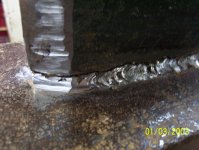
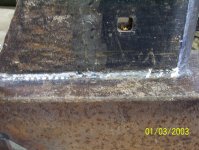
7 1/2 facecords of knarly hickory later, my knife has torn loose from the 10 inch ibeam.
Knife was made of two 1/2 inch grader cutting edges, welded back to back.
Backup gussett is of 1 inch CRS that had laying around.
Welded together with Lincoln 225 buzzbox, 5/32 6013 set on 180 amp.
Gonna try to post a picture.
The CRS gussett held!
Weld is torn where it meets the harder (Grader Blade) steel and some right thru the center of the weld.
Gotta try ta get that puppy back offa there, regrind all way around, then open to suggestions as to where I went horribly wrong!
 

Attachments

  • 100_4588.JPG
    100_4588.JPG
    490 KB · Views: 498
  • 100_4590.JPG
    100_4590.JPG
    560 KB · Views: 445
/ Welding help needed #2  
It doesn't look so much torn as cracked all the way around. It has to do with the dissimilar metals. Many suppliers of wedges recommend welding with a low hydrogen rod. (I think 7018 is a low hydrogen rod) Or maybe preheating and cooling slowly.

There are a lot of welding experts on here and I am sure they will give good advice but you could also check out WeldingWeb™ - Professional Welding Forum - Powered by vBulletin they are a lot like this website, good people, good advice.
 
/ Welding help needed #3  
Hi,

It looks like you've encountered hydrogen induced cracking. As a general practice, the best way to avoid this condition is to preheat the area adjacent to the weld and then weld it in multiple passes. This will accomplish two things. 1. It will slightly anneal the fusion plane. 2. Multiple passes will minimize hydrogen diffusion. If you can, try to grind out as much of the filler material as you can, (v-groove if possible). Preheat the area to a dull cherry and then do a root weld with two more alternating passes over it to fill while it's still hot. Hopefully this will solve your problem. If you decide to try it, let us know if it holds up.

Thanks
 
/ Welding help needed
  • Thread Starter
#4  
Thank You Bernie and Firehouse.
Knew it was probably on account of the dissimilar metals but didn't know what to do about it. Will get back to grinding it off and also will try the link.
We thankyerbellymuch!
 
/ Welding help needed #5  
Yep....I use 7018.There also seems to be some undercutting.
 
/ Welding help needed
  • Thread Starter
#6  
Thanks Bobbobodu
General concensus seem to warrant vgrooving, 7018, with preheating before , during and after letting cool slowly. Gonna also jack up each side so that can lay that puddle in there better to prevent undercutting.
 
/ Welding help needed #7  
Looking at the pictures again after some coffee,I'm not sure I'm correct on the undercutting.Your settings on the welder should be good...I think it's the rod choice.I redid my wedge after the original got beat up pretty badly and took the easy route after bending many that I made outta stuff I had around.Went to the store and bought three splitting wedges and stacked them up on the end of the beam......pushed em right off!! Back to the store for some 7018 and they are still on the splitter after several cords of the nasty stuff the tree company left me.I also suggest making two root passes and one cap...build that sucker up...the log ain't gonna care!! I wouldn't jack it up either....
 
/ Welding help needed #8  
I think the majority of the problem was caused by only having one of the three passes you need there. On logsplitters I make, I weld the cylinder brackets (1" thick) and the foot (2" plate) to a 6" 25# beam with three passes. The first like yours, the second from the beam across ~2/3 of the first, and the last from the bracket/foot to the beginning of the second. Crude drawing attached...
 

Attachments

  • weld.BMP
    312.9 KB · Views: 349
/ Welding help needed #9  
Cutting edge welding usually requires a different rod than mild steel. Check with your welding supplier on the correct rod.:D :D :D
 
/ Welding help needed #10  
ronko said:
Build logsplitter.
Cleaned out the back shed, put it all inna pile and welded it together.
Ground away everything that didn't look like a logsplitter.
7 1/2 facecords of knarly hickory later, my knife has torn loose from the 10 inch ibeam.
Knife was made of two 1/2 inch grader cutting edges, welded back to back.
Backup gussett is of 1 inch CRS that had laying around.
Welded together with Lincoln 225 buzzbox, 5/32 6013 set on 180 amp.
Gonna try to post a picture.
The CRS gussett held!
Weld is torn where it meets the harder (Grader Blade) steel and some right thru the center of the weld.
Gotta try ta get that puppy back offa there, regrind all way around, then open to suggestions as to where I went horribly wrong!

I have a few questions and comments.

First of all, the scraper blades that you used were most certainly heat treated and hardened. Since you have already welded them cold, you have affected (likely ruined) the heat treatment. You have probably hardened them. Since you're only cutting soft wood, this really isn't an issue. But it's something to remember.

Secondly, preheating to a dull cherry is not a good idea. That is way too hot, Again, you'll affect the heat treatment. Preheat to 450*F max on your 1" material, somewhere around 350* for the 1/2" scraper blades. 1/2" material stacked does not equal 1" of solid, so preheat a little less. For a proper preheat, you have to know what the material is. If you don't safe numbers are 250-350*F for your thinner stuff, and 450*F or so for your thicker stuff. These are ballpark figures to help you more than hurt you. Mild steel requires a pre heat for material over 1" thick.

Your electrode selection was wrong. You want a lo-hy such as 7018 when welding alloy steels to mild steel. This will reduce the likelyhood of cracking, just as you got. Remember, when joining disimiliar steels, ALWAYS match the weaker metal.

As for utilizing a multi-pass process, I can not comment unless I know the thickness of the steel you are welding this knife/gusset to. If it is only 1/4" thick, you only need 1/8" of weld ALL THE WAY AROUND your knife, except the cutting edge. That said, 1/4" of weld all the way around is good. Your total weld should match your minimum thickness.

To further clarify, say your base is 1/4" thick. If you were only welding one side, you would need a 1/4" weld. Weld all around? 1/8". If it's 3/8 thick, 3/16" all around or 3/8" on one side. 1/2" thick? 1/4" all around or 1/2" on one side. Piling up 1" of weld on a thin base plate may give you a false sense of security, but you're actually overwelding and affecting your thinner material. Overheating, larger HAZ and so on.

Knock that thing offa there. Grind out all the filler you deposited with the 60xx rod you used, heat it up and re-weld with 7018. Also remember that with pre-heating, it will be much easier to undercut.

Hope this helps.

Allen
 
Last edited:
/ Welding help needed
  • Thread Starter
#11  
thanks all
Well, she's stuck back on there! Good, bad or indifferent!
Got it wrapped in an asbestos blanket till tomorrow.
Went and borrowed an IR Thermo. and bought some 7018.
Practiced yesterday with the 7018 on sticking the two 1/2 in. blades back to themselves. Today with my son's help with the torch, we preheated, kept warm between passes, and stuck the knife assy back to the IBeam. Yes; with preheating it was much easier to drop the vertical base metal into the puddle and had to make an extra pass because of it. Tried jacking, but couldn't really safely get it to a 45 degree. Probably not as pretty or scientific as you like but should have much greater chances of success than the first time. I'm getting pretty good as a grinder, mebbe some day I'll get better as a weldor.
 
/ Welding help needed #12  
One more input. The area that failed is called the "Heat Affected Zone". That's the area adjacent to a weld that is most likely affected by the welding heat, thus changing it's makeup. Temperature at the arc can reach up to 12,000 degrees F. The grader blade you welded is heat treated (hardened) throughout the entire thickness of the metal. Welding altered that area, and thus it failed.
Preheating was the way to go, "Lo-Hi" (low hydrogen rods - low moisture content in the flux coating) rods were also the way to go. 7018 or even stronger rods like the 8018, 9018, 10018 could have been used also.
Slow cooling like you did was good also. Hope it holds up now. Happy splitting (logs that is).
 
/ Welding help needed #13  
ronko said:
I'm getting pretty good as a grinder, mebbe some day I'll get better as a weldor.

That's how it works - in that order!:D
 

Marketplace Items

SKID STEER ATTACHMENT PACKER (A58214)
SKID STEER...
2009 Kubota RTV1140 (A57149)
2009 Kubota...
Rooster Weathervane (A55853)
Rooster...
Unused 2025 CFG Industrial XZ20R Mini Excavator (A59228)
Unused 2025 CFG...
2013 CATERPILLAR 299D SKID STEER (A60429)
2013 CATERPILLAR...
Poly Fuel Tank with Electric Pump (A55851)
Poly Fuel Tank...
 
Top
