creekshorefarms
Member
- Joined
- Oct 18, 2012
- Messages
- 43
- Location
- St. Catharines, ON
- Tractor
- Kubota L3200, Ford 1710, Ford 1310, Farmall Super A (x2)
A little background:
My wife and I own a small scale, commercial vegetable operation on 1ha or about 2.5acres. Given that we don't have a lot of room we generally need to plant things as close together as we can so that we can maximize the space we have, and we grow almost everything from transplants to minimize dead space from non-germinating seeds and to get an early advantage in weed control. When we first began farming we would lay out our rows with a long tape measure and then poke holes in the ground with the end of a hoe or shovel to make a spot for the transplant. This got a bit tedious when you were trying to plant 30 to 80 trays, each with 72 transplants. It also meant only one person of the two of us could be actually planting as the other was only barely able to keep up making said holes.
We looked at commercial transplant units, but came up with 2 main issues:
1. At the time our beds were on 4ft centres and typically had 2 to 7 rows in each bed. The commecial units we found would typically only plant 1 or 2 rows wide and not at the spacing we needed.
2. Sometimes our transplants have very little or no root mass. Leeks or carrots for instance don't really develop a sufficient size or root mass and need to be planting very carefully.
Our next move was to create the "Wheel of Doom". So called because it has 7 rows of spikes that when pulled through the field would mark out the holes for us.

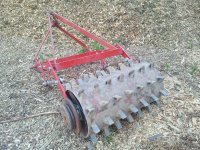
Originally it had cultivators in front, but they didn't make the ground smooth enough for the spikes to mark a hole so we removed them and used a rototiller set shallow first, then went over with the wheel. This has worked ok, but thanks to the geometry of the spikes they tend to kick the dirt on their way out of the hole and fill it partially back in. While we could still see where we were supposed to put the transplant, we had to either open up the hole with our fingers, or force the seedling into the ground. This added more time to the process and was probably not great for the root system. Sometimes the holes were so bad you just had to guess where to put the plant for a few feet.
While just changing the geometry of the spikes would have almost been enough, we wanted something a little better. A neighbouring farm was out prebedding with their raised bed maker (prebedding is when you make a bed in the field with no plastic before going over it again with plastic...makes a firmer and more even raised bed for the plastic and keeps it tighter), I asked if I could try my wheel on the beds and it made a significant difference running the spikes over a slightly packed, more level surface.
So this leads me to my post title. My current plan is to build a raised bed maker, modify the "Wheel of Doom" and combine them into one package to give me a better end result.
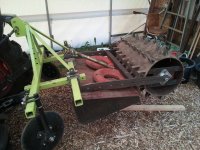
While I am a bit further in the process then I have posted here, I don't have time to post it all here, plus this is getting long already so I will leave you with a couple photos of the toolbar, which has been seen already in another thread.
Before paint:

After paint:

More to come soon...
My wife and I own a small scale, commercial vegetable operation on 1ha or about 2.5acres. Given that we don't have a lot of room we generally need to plant things as close together as we can so that we can maximize the space we have, and we grow almost everything from transplants to minimize dead space from non-germinating seeds and to get an early advantage in weed control. When we first began farming we would lay out our rows with a long tape measure and then poke holes in the ground with the end of a hoe or shovel to make a spot for the transplant. This got a bit tedious when you were trying to plant 30 to 80 trays, each with 72 transplants. It also meant only one person of the two of us could be actually planting as the other was only barely able to keep up making said holes.
We looked at commercial transplant units, but came up with 2 main issues:
1. At the time our beds were on 4ft centres and typically had 2 to 7 rows in each bed. The commecial units we found would typically only plant 1 or 2 rows wide and not at the spacing we needed.
2. Sometimes our transplants have very little or no root mass. Leeks or carrots for instance don't really develop a sufficient size or root mass and need to be planting very carefully.
Our next move was to create the "Wheel of Doom". So called because it has 7 rows of spikes that when pulled through the field would mark out the holes for us.
Originally it had cultivators in front, but they didn't make the ground smooth enough for the spikes to mark a hole so we removed them and used a rototiller set shallow first, then went over with the wheel. This has worked ok, but thanks to the geometry of the spikes they tend to kick the dirt on their way out of the hole and fill it partially back in. While we could still see where we were supposed to put the transplant, we had to either open up the hole with our fingers, or force the seedling into the ground. This added more time to the process and was probably not great for the root system. Sometimes the holes were so bad you just had to guess where to put the plant for a few feet.
While just changing the geometry of the spikes would have almost been enough, we wanted something a little better. A neighbouring farm was out prebedding with their raised bed maker (prebedding is when you make a bed in the field with no plastic before going over it again with plastic...makes a firmer and more even raised bed for the plastic and keeps it tighter), I asked if I could try my wheel on the beds and it made a significant difference running the spikes over a slightly packed, more level surface.
So this leads me to my post title. My current plan is to build a raised bed maker, modify the "Wheel of Doom" and combine them into one package to give me a better end result.
While I am a bit further in the process then I have posted here, I don't have time to post it all here, plus this is getting long already so I will leave you with a couple photos of the toolbar, which has been seen already in another thread.
Before paint:
After paint:
More to come soon...