my dilemma

   / my dilemma #1  

MikeA57

Silver Member
Joined
Jun 22, 2010
Messages
238
Location
N. Mississippi
Tractor
Ford 1510
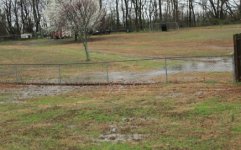
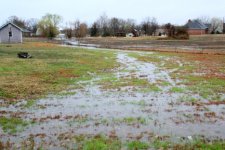
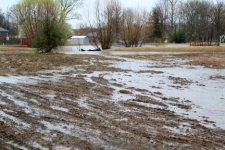
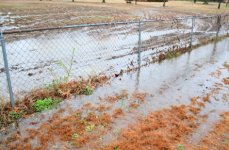
OK guys, last week I posted a thread asking about box blading with turf tires on my tractor. It rained a LOT last night and my back yard swamp has reappeared so this morning I went out and took some pictures of the raging waters. This is NOT the worst it's been. It has come down to the point that I would've been scared to cross this area it was running so fast. But this gives an idea of what I'm dealing with. I've attached pictures of the runoff and also an overhead view of the path it takes. I know the pictures don't give a clue as to the actual terrain and slope but I'll try to get elevations of the areas once it stops raining to add to this.

The red lines on the picture indicate the path of the water as it runs across the properites. The orange circular area is where it pools up when the pond gets too full and the blue circles are mounds of dirt left over from previous digging (before I owned this place). The smaller one is from the dig out of the pool in the upper left of the picture and the larger one was moved from where the pond was dug out. I own both lots in the picture (green lines) so making grading changes is entirely up to me. I've got a son in law who works for a company that has bobcats with FELs that I can get onsite.

Here are my initial thoughts:
Area 1 - use dirt from the mounds to build up on either side of the water run just to try to keep it focused as it runs.

Area 2 - I'm thinking of digging out where it runs from my back yard to the back lot over towards the pond, again just to channel it. I'm not talking about digging it out much, just to define the run more.

Area 3 - I would use more dirt to line and define the edges.

Area 4 - The runoff from this neighbor's yard is much less than the others but it too needs focusing so it's not so wide as it runs down. I would try to build it up again on either side to do this.

I've still got to cut both lots so anything I do can't be so drastic that it prevents that. Do these ideas make sense?
 

Attachments

  • 1-From the neighbors yard.JPG
    1-From the neighbors yard.JPG
    127.2 KB · Views: 295
  • 2-Across my backyard.JPG
    2-Across my backyard.JPG
    133.9 KB · Views: 284
  • 3-Crossing over into the back lot (I own also)JPG.jpg
    3-Crossing over into the back lot (I own also)JPG.jpg
    138.3 KB · Views: 245
  • 4-Then across the back lot to the neighbor's pond.JPG
    4-Then across the back lot to the neighbor's pond.JPG
    142.3 KB · Views: 274
  • 5-Water also comes down from neighbor's yard next to back lot alsoJPG.jpg
    5-Water also comes down from neighbor's yard next to back lot alsoJPG.jpg
    152.5 KB · Views: 246
  • Overhead view of backyard swamp.jpg
    Overhead view of backyard swamp.jpg
    57.7 KB · Views: 360
   / my dilemma #2  
You sure have my sympathies, my son and I are doing something similar to keep the water off of our firing range and we are using an M8540 and L5030. We had a Bobcat 864 out there for a while, but it did not work well for moving large amounts of dirt though it was great for digging. We will finish up this spring. We would have completed it already, but we are also building up berms.

We have been going by checking water flow and judging heights, but will finish up with a transit.
 
   / my dilemma #3  
I've got some drainage issues on my place, too. I have considered moving dirt around to either raise the low ground and make it high enough that it dries out faster.

Lately, I've begun to consider the use of drainage tiles or underground piping similar to the perforated PVC tubing used in leach fields for septic systems.

The perforated pipe would be buried in a 2 foot deep trench and routed towards an area that I don't plan to mow or crop i.e.; a pond or catch basin.

In your situation, the buried pipe could be directed towards the pond, for example. 'Course you'd have to use a pretty accurate transit with the slope of your trench @ 1-2%.

Another consideration would be to ensure that the pipe did not seal up over time with sediment but would continue to drain off the flood waters to the pond.

A possible source of information might be your local NRCS office or county extension agent. They might have solutions that will keep you outta trouble with your neighbors, the county and maybe the EPA....

Best of luck.

AKfish
 
   / my dilemma #4  
I didn't study every detail, but in general you want to enhance what the water is trying to do now and provide a defined swale to the pond. a box blade would work nicely for that job.

I dried up a low wet area on my property with a drain swale down the middle. the trick is to work with the topography as much as possible, the best way to do that is to observe it when it's flooded, like in your pictures.

JB.
 
   / my dilemma
  • Thread Starter
#5  
Thanks guys, good suggestions there.

AKFish, I had completely forgotten about it until you started talking about burying pipes, but right across the fence in back lot is a sewer pipe that travels the whole length of the fence, then turns to go up along the neighbor's lot by area 4. So anything that I do is going to have to be done on top.
 
   / my dilemma #6  
If it were just Mother Nature at work, in maybe 50 years there would be a naturally made gully or stream for carrying that drainage to the pond. But it's also your field now and you've got to come up with something that will keep you and Mother Nature happy.

Underground piping isn't the answer... you get a torrent coming through periodically that would overwhelm anything less than gigantic. Keep in mind anything you do to narrow the channel of water will increase how fast it flows, maybe increasing the erosion process, since you might wash out any vegetation you try to grow. It might be your best option is to give the water an erosion resistant channel to follow (i.e. lined with rip rap, for example).

I would consult with an engineer, soil conservation department or ag extension service to get on-the-scene advice.
 
   / my dilemma #7  
JB4310 has a good idea, a boxblade could do you a world of good in this instance. You don't want a river, just a diversion.

Seeing the property would be the best thing, but, it looks like you have a workable plan.

The treeline at the back, and down the right side............doesn't show much on the pics, is there a potential problem there also?

The orange area...........'without seeing the lay of the ground in person'.............I think you may be stuck with it.
 
   / my dilemma #8  
I looks like you have a natural swale that provides drainage. You just need to enhance it so the middle is a little deeper and turn it from several yards wide to just several feet. It doesnt need to be a deep ditch to drain that land. If you have a good eye you could do it with a box blade, but to get the correct fall all the way so you dont have any standing puddle areas, you need to be using a surveyor level or laser level to check the grade all the way. You could start with just a few passes with a straight blade or box blade that is tilted slightly to make a slight swale and then wait for the next rain to see what happens or rent a level to check your fall as you ditch. You would need to run a land plane over the low areas after you ditch it to make sure you arent leaving some dams that block the inflow of water. THis could make it worse than it is now if you throw up a berm between the swale and the the higher land, it will move the standing water back up the hill. We had a swamp on our land that ran parallel to a creek. It couldnt drain into the creek because there was a high ridge that blocked it from getting there so it was always full of water. We finally got a dry spell last year that allowed us to move that ridge into the swampy area and allow the whole thing to drain naturally again.
 
   / my dilemma #9  
If it were just Mother Nature at work, in maybe 50 years there would be a naturally made gully or stream for carrying that drainage to the pond. But it's also your field now and you've got to come up with something that will keep you and Mother Nature happy.

Underground piping isn't the answer... you get a torrent coming through periodically that would overwhelm anything less than gigantic. Keep in mind anything you do to narrow the channel of water will increase how fast it flows, maybe increasing the erosion process, since you might wash out any vegetation you try to grow. It might be your best option is to give the water an erosion resistant channel to follow (i.e. lined with rip rap, for example).

I would consult with an engineer, soil conservation department or ag extension service to get on-the-scene advice.


I agree, too much water for small perf pipe and without seeing it in person it is hard to say what you need to do. A wide grassy swale planed smooth would be the best thing since you wan't the water to move as slowly as possible to prevent erosion.

I agree with others to try to fix any places where water can pool by smoothing with a boxblade or landplane. I would smooth it and get some grass seed on it asap. You may need to seed it several times before you get full coverage. A bad storm can always be a game changer causing you to have to start over though.:(
 
   / my dilemma #10  
Gradually defining where you want the water to flow towards the pond with a box blade (and quickly re-seeding to prevent erosion) sounds like a good plan.

Can not tell by the picture, but where does the pond water overflow to when the pond becomes full? It sorta looks like the far side of the pond (opposite your property's drain flow swail) is the overflow for the pond for when it becomes full. Regardless, I would want to know where the pond overflow is and where the excess pond water has to go before I altered things.

Also, I have had good luck using a cheapy 3-pt subsoiler attachment to break up subsoil clay to get the water to simply soak into the ground quicker in those areas where it is not feasable to divert water away. Be mindful of existing drainage tiles, sewer lines, fiber optic lines, power lines etc. before attempting to subsoil anywhere. The subsoilers are great in that minimal damage is done to the existing turf - simply looks like a big knife slit in the ground, but they drastically help the water soak into the ground. Subsoiling can last in an area for multiple years too. It has been several years since I last subsoiled some of my problem areas, but I do plan to do hit them again this year though.
 
   / my dilemma #11  
Gradually defining where you want the water to flow towards the pond with a box blade (and quickly re-seeding to prevent erosion) sounds like a good plan.

Can not tell by the picture, but where does the pond water overflow to when the pond becomes full? It sorta looks like the far side of the pond (opposite your property's drain flow swail) is the overflow for the pond for when it becomes full. Regardless, I would want to know where the pond overflow is and where the excess pond water has to go before I altered things.

Also, I have had good luck using a cheapy 3-pt subsoiler attachment to break up subsoil clay to get the water to simply soak into the ground quicker in those areas where it is not feasable to divert water away. Be mindful of existing drainage tiles, sewer lines, fiber optic lines, power lines etc. before attempting to subsoil anywhere. The subsoilers are great in that minimal damage is done to the existing turf - simply looks like a big knife slit in the ground, but they drastically help the water soak into the ground. Subsoiling can last in an area for multiple years too. It has been several years since I last subsoiled some of my problem areas, but I do plan to do hit them again this year though.

Very good idea for many applications.

How to use a subsoiler
 
   / my dilemma #12  
Build yourself a little catfish pond with some perf pipe buried along the path that water is flowing. We used sediment fabric over the perf pipe we buried at a friends place. He put the pipe just under the surface on pea gravel so that he could channel the water away from his crawl space. Then plant some Marshy water loving plants around your pond to attract birds and butterflies. If the water source is going to dry up in the summer then don't put any fish in it.
 
   / my dilemma #13  
Gradually defining where you want the water to flow towards the pond with a box blade (and quickly re-seeding to prevent erosion) sounds like a good plan.

Can not tell by the picture, but where does the pond water overflow to when the pond becomes full? It sorta looks like the far side of the pond (opposite your property's drain flow swail) is the overflow for the pond for when it becomes full. Regardless, I would want to know where the pond overflow is and where the excess pond water has to go before I altered things.

Also, I have had good luck using a cheapy 3-pt subsoiler attachment to break up subsoil clay to get the water to simply soak into the ground quicker in those areas where it is not feasable to divert water away. Be mindful of existing drainage tiles, sewer lines, fiber optic lines, power lines etc. before attempting to subsoil anywhere. The subsoilers are great in that minimal damage is done to the existing turf - simply looks like a big knife slit in the ground, but they drastically help the water soak into the ground. Subsoiling can last in an area for multiple years too. It has been several years since I last subsoiled some of my problem areas, but I do plan to do hit them again this year though.


In addition to subsoiling the problem area it can help with the areas that are feeding this low spot. Might slow down the surface run off considerably.
 
   / my dilemma #14  
Drainage tile will take care of that no problem. Just avoid the sewer pipe. Capacity is not a problem. All that water in the picture didn't come all at once. The tile will carry it off as it comes, and in no way be overwhelmed. I've seen a lot worse than that be cured with tile runs. May need a couple to do it, but you'll be done.
 
   / my dilemma #15  
Drainage tile will take care of that no problem. Just avoid the sewer pipe. Capacity is not a problem. All that water in the picture didn't come all at once. The tile will carry it off as it comes, and in no way be overwhelmed. I've seen a lot worse than that be cured with tile runs. May need a couple to do it, but you'll be done.

If it was just standing or very slow moving water like the pictures show, I'd agree that drain tile would handle it. But Mike also says, "It has come down to the point that I would've been scared to cross this area it was running so fast" in his original post (italics added). If that's true, what he's got is a fast-running stream that's at least 10 feet wide and maybe a foot deep running through his place every time there's a heavy rain, and I'm thinking that amounts to thousands of gallons per minute flowing there. That's really not a drain tile kind of problem, do you think?

The reason I suggested seeking some expert advice is it looks like there should be a stream bed where the water has flowed over time. Since there isn't, it has either been covered over or the natural water flow has been diverted somehow upstream and now follows a new channel on to Mike's land. It may even be a floodplain area. Knowing something about why the water is flooding the field will help find the best way to handle it.
 
   / my dilemma
  • Thread Starter
#16  
Thanks for all the ideas guys. I'll try to address the questions posed.
I will say that I was fairly impressed with how quickly the water seemed to disappear from the area this time. I did not go back out and wander around out there but at least it didn't stand there like it had in prior years. Maybe all the damage my son did to it with 4 wheeling made it soak in quicker. DIY subsoiling??

Rankrank1: You are correct sir! The overflow is at the other end of the pond out of the picture I included.

Grandad4: When it came down that hard was the same storm system that flooded Nashville last year. I think they called that a "once in 500 year" rain event. So hopefully, I won't see it run like that again. And, I found a site that archives aerial images and I found aerials of that area dating back to 1937!! (Fortunately I made screenshots of them because when I went back out a couple of weeks later they had been pulled.) So I was able to see the area as it existed in '37, '59, '68, '76, '81 and later. The area where the water flows now across the back lot actually was a creek (The pond of course did not exist). So the water is doing exactly what it has done for eons.

Don87: Yeah, the tree line is a series of evenly spaced oak trees right on the neighbors property line. His house is elevated above that back lot so when it rains real bad it does drain through those trees and curves into the main run. One of the reasons that the orange area exists is because the guy that owns the pond put up a silt fence to stop the dirt from draining into his pond and filling it up. He did that once my son started riding back there on ATVs and tore up the grass. I think if I get it draining right and maybe put some rock in there that may solve the silt problem but I'm not sure.

I like the idea of achieving the desired results with a boxblade or land plane. I'm not looking to do a complete dig out of the area. I thought at first that drain tiles would be required but the more I studied it, I realized that it would be more labor intensive than I was wanting to do if I could get away without doing that.
 
   / my dilemma
  • Thread Starter
#17  
That subsoiler is a COOL TOOL!! I've never seen one of those before. Ted makes some very informative videos. That might help all throughout that area because it stays real wet down there for a good while. 2 years ago we had so much rain over a month period that it was another month before I could get out there to cut it with my zero turn. And I darn near burned it up cutting it. That's why I bought the tractor.
 
   / my dilemma #18  
It looks like the soil is a clay which will not let the water absorb in the ground very fast. So maybe you could dig a trench for the run off and fill with rock to breakup the ground so i'll aborb quicker. Also call your farmers co-op and ask them on how to resolve the problem. Just a thought.
 
   / my dilemma #19  
All the best with your grading project, Mike. I'd think you want to make the swale, or channel, wide and shallow so you don't have as much soil to move and you keep the flow of drainage fairly slow to avoid erosion. Speaking of which, as already mentioned, you will have something of a scheduling challenge getting the dirt work done and something growing before a gully-washer hits (aptly named, eh?) and spoils all your hard work. You may want to tackle it in phases so you are sure to get them completed. Do you maybe have a particular season when you usually get an extended dry spell in your area?

The subsoiler and the tile may indeed be helpful additional measures once you get the basic work done.

If you are so inclined, sharing pictures of your progress is something appreciated by most TBN members.
 

Marketplace Items

2013 Godwin Dri-Prime CD103M Towable Trash Pump (A59228)
2013 Godwin...
2014 MAGNUM PRODUCTS LIGHT TOWER COMBO (A55745)
2014 MAGNUM...
2013 CATERPILLAR 336E L (A58214)
2013 CATERPILLAR...
2020 MACK GRANITE (A58214)
2020 MACK GRANITE...
Zero Turn Mower (A59231)
Zero Turn Mower...
2006 JAYCO JAYFLIGHT 30' TYPE CAMPER (A58375)
2006 JAYCO...
 
Top