back hoe hydrolics

   / back hoe hydrolics #1  

simplicityguy92

Bronze Member
Joined
Mar 5, 2008
Messages
88
what size hydrolic cylanders do i need for
for a backhoe with a 10 ft lift arm and 8 foot dipper
im only 15 and just learned how to fabricat so i need some help

the backhoe would be 3 pt but go on to my skidsteer with a 3pt quik hitch so
 
   / back hoe hydrolics #2  
I have been building and fabricating for nearly 40 years now,

and I jsut finished a backhoe of my own design, I first bought 2 or 3, sets of plans and down loaded a few free plans as well, and down loaded pictures from eBay and many many pictures off the net, to study designs and ideas, and also started to collect parts manuals and part books,

also down load or get brochures from many manufactures, usually the pictures are nearly a set of plans, Grid them and then enlarge them,
How To Enlarge a Drawing Using a Grid | eHow.com
Drawing Using a Grid

if you copy an existing design you will benefit your self, by letting some one else do much of the design work,

much of the cylinder size, needs to be balanced with the strength of the materials one uses, and design, if one uses short strokes one will need larger cylinders and if one uses long stroke cylinders they can be smaller as you will have more travel and be using more leverage, and the hydraulic pressures one uses.

so to answer your question is not some thing one can do with a lot more information, and know the design and what your wanting to have for power, and abilities,

your dealing with a "large" backhoe for a home built unit with those dimensions,

but one could built it with 2,1/2" cylinders and one could built it with 5" cylinders, and both will dig, and depending on the materials one uses, you may jsut bend it in to scrap iron or it may be under powered, some will depend on the strokes you chose as well. and the leverage one designers into the machine,

again being 15, the back hoe project I jsut finished would have overwhelmed me at that age, and I do feel I have above average mechanical ability, and was a fair welder that that age.

first one needs to consider the cost, and it my be that your independent wealthy, but I used 95% scrap iron out of some old machinery to built my machine, so the steel was not much of an issue, but the hydraulics cost me close to $2000 before I was done, cylinders, valves, fittings, tubing, hoses, etc,

my recommendation is to get a set of plans if your serious, and follow them or enlarge them a few percent to get the unit your desiring,
(personally I think that may be a real challenge for you and my guess of your skills),
if your really intent on it, search EBay or wrecking or scraping yards, or other, and buy a junker and rebuilt it, new bushings and or cut our and have new bushing made and weld them in, and rebuilt the hydraulics, it will be probly be cheaper than buying steel.

IF your intent on doing this, study a multitude of designs, get basic books on basic hydraulics and principles,
and get a friend that is a good fabricator and buddy up with them so they can mentor you, and listen to there guidance, learn and learn and learn some more, study and study, you will be benefited if you have access to a machine shop as well, a minimum of a large drill press capable of drilling up to 2,1/2" holes, a set of large reamers, for reaming and aligning of the pivot points, and reaming out bushing stock, and other.

If you do one from scratch you will encounter many many obstacles in the construction of

see here is a 'lighter duty hoe" the reach is close to what your wanting to build,

Truckhoe&Towable Truckhoe - Versatile Backhoe Alternative
it is using 25 gallon a min, hydraulics
a heavy duty unit would take much more,

an unless you have a fairly hefty skid steer loader that is a lot of back hoe, and you would probly need stabilizers as well, to use it efficiency,

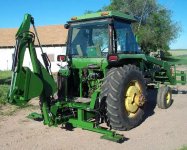
mine is smaller than what your design parameters are as you stated them, (not a micro) but I have it mounted on a 8000 pound 100 hp tractor, and if you do not put the stabilizers now it will shake the tractor all over, (it has a sub frame),

attached is a picture of the unit I jsut finished,
 

Attachments

  • april 08 005.JPG
    april 08 005.JPG
    47.8 KB · Views: 364
Last edited:
   / back hoe hydrolics #3  
one other thing if you design this and or if you follow plans, make full size patterns (cardboard or ply wood) of all pieces and (use small bolts and washers) to make pivot points, and make sure all things will bend and turn and clearances will be adequate, for all bending points, room for hoses and no binding of cylinders, (you can lay out the cylinders on the floor, closed and extended) and use actual cylinders or you can make mock up cylinders out of template materials to make it in all positions, but if one does this it may eliminated some mistakes and or broken bent parts.

also when sizing your cylinders your gallons a min you have may make some difference to what is chosen, to large it will be very slow, to small it may be to fast, and be uncontrollable.

so there is a lot in how to size the cylinders.
 
   / back hoe hydrolics #4  
simplicityguy92 said:
what size hydrolic cylanders do i need for
for a backhoe with a 10 ft lift arm and 8 foot dipper
im only 15 and just learned how to fabricat so i need some help

the backhoe would be 3 pt but go on to my skidsteer with a 3pt quik hitch so

A backhoe with a 10' boom and an 8' dipper sounds like an awfully big backhoe to fit on a skidsteer. The structure required to keep those 2 parts from deforming when in opertion are going to make this thing VERY heavy. Not to mention the pivot structure required to swing it. I think that size backhoe would lead to a case of the tail wagging the dog. Those dimensions are what I would expect to see on a very large tractor(greater than 100HP and 3+ ton in weight?). I would think something smaller with say a 5' boom and a 4' dipper and about 6' depth of dig would be more appropriately sized to a skid steer. Something more along the lines of what you would see on a 30HP tractor.

What are you building it for? I find it best when designing something to set a performance goal, and build as necessary to reach that goal. I don't think a skidsteer is going to be an acceptable base to build a hoe with a 15' reach from, at least a hoe that will last beyond it's first use. All the forces applied on that boom need to be supported back thru the skidsteer loader arms...

Do you have anywhere around you that has backhoes such as tractor dealerships or rental stores? Go get some hands on and see how some are actually built, the thickness of the plate used, the size of the pins and pivots. There is a reason they are built like that, as the forces involved are massive, even on a small hoe.

Good Luck
 
   / back hoe hydrolics
  • Thread Starter
#5  
i only used 1o ft and 8ft beacause therir easy numbers to diveid from to scale down to 5 and 4 ft for my bobcat.
iv done abit of fabricating eg. snow plow, brush forks, backblade in process, and i manuer forks in progress for my small tractor so i thought id make somethiing more comlicated for the bobcat.
 
   / back hoe hydrolics
  • Thread Starter
#6  
the laying it out with cardboard is a good idea.
 
   / back hoe hydrolics #7  
simplicityguy92 said:
i only used 1o ft and 8ft beacause therir easy numbers to diveid from to scale down to 5 and 4 ft for my bobcat.
iv done abit of fabricating eg. snow plow, brush forks, backblade in process, and i manuer forks in progress for my small tractor so i thought id make somethiing more comlicated for the bobcat.

Good grief, can't you play video games like every other 15 year old.:D
I have to admit I'm a tad bit jealous as to how ambitious you are. I see a great career as a craftsman in you future.

Where do you live? I might have some work you could do for me. :D

And last but not least. We hear at TBN expect pictures of the project. Heck I'd like to see some of the other stuff you built.

Wedge
 
   / back hoe hydrolics #8  
I think it's outstanding that you want to do this...at any age!
Just be sure to get a decent design so it is structurally sound. I see you have a lot of fabricating skill, so might as well put it to good use.
Kids like you are hard to come by these days.
I predict you will end up as a very successful person, whatever you choose to do in life.
 
   / back hoe hydrolics
  • Thread Starter
#10  
wedge40 said:
Good grief, can't you play video games like every other 15 year old.:D
I have to admit I'm a tad bit jealous as to how ambitious you are. I see a great career as a craftsman in you future.

Where do you live? I might have some work you could do for me. :D

And last but not least. We hear at TBN expect pictures of the project. Heck I'd like to see some of the other stuff you built.

Wedge

why play videogames when i can work in the shop.
 
   / back hoe hydrolics
  • Thread Starter
#11  
when i can get the camera to work ill put the pics on the internet
i got to fix the blade though
tore the angle plate of when a corner hit a buirredboulder and i didnt notice
im the only kid in my shop class to try anything above soapbox racers
 
   / back hoe hydrolics
  • Thread Starter
#12  
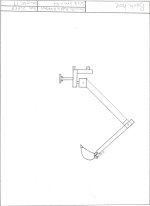
backhoe.jpg
above is the my first back hoe drawings.
 
   / back hoe hydrolics #13  
are you wanting some sugestions on your drawings?
 
   / back hoe hydrolics
  • Thread Starter
#14  
ya that would be great i didnt add hydrolics beacause i dont know how big so i couldnt do them to scale.

ill put pics of the snow plough on a differnt discussion.
 
   / back hoe hydrolics #15  
I would suggest some dimensions so one has an idea of what the length and size of materials your working with.

I would suggest a hing/pivot, that has two points of support, top and bottom,

If you want 180 degree pivot, one more than likely will not be able to have a solid shaft through the middle unless one uses a chain or some type of movable link or rack and pinon system,

you can get about 140 degree pivot with a solid shaft in the pivot,

my guess is your dipper arm has not enough distance above the pivot point to give enough leverage for your desired wants,

If you are intent on the length of dipper and boom (10 and 8 foot), my guess is you will want cylinders in the 3" to 5" diameter and more than likely you need cylinders in the 30" to 50+" in length to make it work,

before one can work out the lengths and the leverage points one will have to start with some potential cylinders in length and there closed and extended dimensions, other wise about all your doing is making a picture,

as the length of the cylinders will be one of the major design points, and one of the things that will be used to make it work and to design your lengths of leverage and so on.

like I suggested, you may be best to some Internet searches and down load some brochures and pictures of backhoes, and get there specs, and see what there using for cylinders and take there picture and blow it up and start to dimension it and then proportion it to your needs, and adjust the cylinder's to match,

and some of your design of your cylinders is what your power unit has for pressure and gallons a min, of hydraulic capacities,

if it is only a 1000 psi system then your cylinders would need to be nearly 3 times the size IN SQUARE INCHES, (area) than a system that is using 3000 psi,

so jsut because a unit has cylinders, that are 5" in diameter 2.5 x 2.5 x 3.14 = 19.625 square inches, X 1000 psi you will have a push of 19,625 pounds, on the return stroke you need to figure the size of the rod and subtract the rod size.

on a 2000 pound system a 3.5 cylinder will nearly be the same, 1.75 x1.75x3.14 = 9.61625 x 2000= 19,232.5 pounds of push,

so before one can figure out your cylinders you will need to know what your skid loader has for auxiliary hydraulic power. and then start to design from there.
 
   / back hoe hydrolics #16  
It may seem like doing the job twice; but making cardboard and/or plywood mock-ups will save you a lot of grief and money when you start fabricating for real on this ambitious project.
 
   / back hoe hydrolics
  • Thread Starter
#17  
i wanted to now if the backhoe in the pic would work
sorry i forgot dimensions it has a 5' arm ,4' dipper ,2' outriigers
 
   / back hoe hydrolics #18  
sorry I messed up and only posted about half of the plan, it is in two URLs

http://www.machinebuilders.net/plans/gallery/Tractor Equipment/Free Backhoe plans-1.pdf

http://www.machinebuilders.net/plans/gallery/Tractor Equipment/Free Backhoe plans-2.pdf

the machine is about the size that your drawing, it has the hydraulics and the basic plans, you basically need the second page it has the dipper and the boom and bucket,

it does not have hydraulic out riggers, but you could probly use the stationary out riggers and jsut lower it to the ground once mounted on the skid steer,

on the frame you would basically jsut want the part from the out rigger tube forward and then a heaver up right for your three point mount,
you would probly have to modify the pivot cylinder to a side mount instead of the rear push/pull it is a possibility two small side cylinders opposite of each other would work better for a three point mount.
take a look at this picture and you may get an idea what I am trying to say,
Backhoe, Build a backhoe, these plans show you how.

some other links you may get some ideas off of.

Micro Hoe <BR>pics 2

CadPlans Corporation - Where you can find designs, tips and order information to build your own backhoes, diggers and MORE!

calculators for a number of different things, hydraulics and sprockets
Baum Hydraulics :: Spec Calculator

~~~~~~~~~~~~~`

I will not say your drawing will not work but as I stated in a early-er post, I think there are some improvements that could be done,
 
   / back hoe hydrolics #19  
It is useful to see a professional use a backhoe, to see what sort of strains they put on the machine, and how they use it. As pointed out, the lower pivot point needs to be quite strong (upper and lower bearing) - it is normal to back the tractor up to your trench line (assuming you are digging a trench, such as for pipe work or similar) and then "fine tune" your alignment ontop of the trench centre line. This involves lifting up the rear of the tractor by pushing the hoe down into the ground (hoe bucket centred on trench centreline) and then (with the tractor rear wheels still in the air) pivot the lower joint until it also lines up over the centreline of the trench. Then when you drag the hoe bucket in towards the tractor it moves along the trenchline (nice, clean & straight trench).

It might sound like this puts a lot of strain on the pivot, but it is a lot less than when you curl the hoe bucket under an unmovable rock and try to lift it out of the ground - still this gives you a good idea of what that lower pivot is going through - lots of strain.

I have an old (heavy) backhoe, the lower pivot is supported above and below, and the supports look like solid 1 inch steel plate. And they have stress fractures in them. It's heavy, clunky, cantankerous and blows a hose occasionally - but lots of fun.

I'm sure you'll enjoy your hoe when built. My only other advise (in case you don't have heaps of money to spend on building the hoe) is to start by scrounging hydraulics - with an eager approach you might find sympathy in a local hydraulics workshop or scrapyard, and having scrounged hydraulics then design your hoe to fit around the bits you have.
 
   / back hoe hydrolics
  • Thread Starter
#20  
thats only 1 of my drawings ive bin looking at lots of backhoes on the internate and have drawn a couple more since
thanks for the ideas
 

Tractor & Equipment Auctions

2025 Ligchine Spiderscreed Concrete Screed (A59228)
2025 Ligchine...
2024 New Holland T8.410 MFWD Tractor (A55314)
2024 New Holland...
2010 International 4300 2,000 Gallon Water Truck (A55973)
2010 International...
2014 FORD F-150 STX EXT CAB TRUCK (A60430)
2014 FORD F-150...
HYDRAULIC THUMB CLAMP FOR MINI EXCAVATOR (A58214)
HYDRAULIC THUMB...
2020 Ford F550 - 6.7L Powerstroke Diesel -54k Miles (A56438)
2020 Ford F550 -...
 
Top