Difference between commercial and automotive wiring?

/ Difference between commercial and automotive wiring? #1  

farm boy00

Veteran Member
Joined
Jul 17, 2014
Messages
1,296
Location
Howard City, MI
Tractor
John Deere M&MT, Case 1030 comfort king, Sears ST16, Craftsmen 6000, homemade articulation mini-loader
What is the real difference between regular commercial wiring and automotive? Only thing I can think of is automotive is more flexible but I could be wrong?

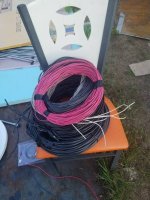
Asking because I'm doing some aftermarket lights on a 98 ford ranger and have piles of commercial wiring out of a restaurant and it's all free. My plan was to use some 8ga with a fuse for main line to toggle switches then 12 ga to lights. Yes I know 12ga is over rated but it's free.

Picture is just some of what I have. 20180724_203047.jpeg
 
/ Difference between commercial and automotive wiring? #2  
Consider a relay for activating the lights circuit (switch --light gauge wire-- relay --heavier wire-- bulbs), especially if they're incandescent.
I can't answer your question; I've always used whatever wire I had lying around in my truck...
 
/ Difference between commercial and automotive wiring? #3  
There is also marine wiring. I assume by commerical wire you mean stuff like romex or THHN type wire. I don't have an official answer for you, but here are things that are considered when making wire.
- voltages that will be on the wire - determines how thick and what type of insulation to use
- the environment the wire is expected to be used in - determines the type of insulation to use (wet, dry, heat, cold, sunlight exposure) and how to structure the conductors (i.e. size and number of conductors)
- what frequencies it is expected to carry - determines the structure of the conductors (this is not really a factor until you get into high frequencies as in radio)
- the anticipated application - metals have a tendency to work harden and get brittle when they are bent, when they get brittle, they break.

Note - If you're using wire in an auto and in the engine compartment, it gets really hot under there and I doubt that "common wire" will withstand that very long. There is a special insulation for wire used in this environment and most likely have to be special ordered. If you're staying within the cabin, it can still get around 140* F. Can your wire insulation with stand that?
 
/ Difference between commercial and automotive wiring? #4  
There are several differences based on what environmental conditions,temperature,vibration/flex and other things wire is expected to see. "Commercial"really isn't a type wire. The single most important factor to be aware of when replacing wire is # of strands that make up the guage. Comparing 14 gauge residential home wire to automotive you will notice romex has a single strand,THHN multiple strands and automotive has even more strands than THHN. More strands not only increase's flexibility,it directly increase's ampacity,esp dc current. Where you can see how difference in strands make's a difference in amp capacity is battery booster cables. The super star amoungest ever day use wire is welding cable,good one's have hair size strands.
 
/ Difference between commercial and automotive wiring? #5  
In a building normally solid wire is used, the assumption is that once it's placed it will never move. In a vehicle normally stranded wire is used, the assumption is it will be subject to vibration and flexing. Solid wire will crack if it is repeatedly flexed.

Vehicles are typically 12 volts, buildings are typically 120 volts or more (in the US). Power is volts times current, so to transmit the same power vehicle wiring has to carry ten times as much current. On 120 volt household wiring a 500 watt light needs 4 amps of current, which can easily be carried by an 18 gauge lamp cord. The same 500 watt light on 12 volts needs 40 amps of current, which would require an 8 gauge wire.
 
/ Difference between commercial and automotive wiring?
  • Thread Starter
#6  
Consider a relay for activating the lights circuit (switch --light gauge wire-- relay --heavier wire-- bulbs), especially if they're incandescent.
I can't answer your question; I've always used whatever wire I had lying around in my truck...
Will be doing either all led lights or lights within toggle switch ratings. Don't really have much space for relays under the hood in the first place let alone after wiring for a plow (needs solenoid but may put on plow frame itself)harness, lighting harness, and maybe a salter.
 
/ Difference between commercial and automotive wiring? #7  
It’s hard to connect a big wire to a little light wire especially if it’s solid conductor but besides that I don’t see a problem.
 
/ Difference between commercial and automotive wiring?
  • Thread Starter
#8  
There is also marine wiring. I assume by commerical wire you mean stuff like romex or THHN type wire. I don't have an official answer for you, but here are things that are considered when making wire.
- voltages that will be on the wire - determines how thick and what type of insulation to use
- the environment the wire is expected to be used in - determines the type of insulation to use (wet, dry, heat, cold, sunlight exposure) and how to structure the conductors (i.e. size and number of conductors)
- what frequencies it is expected to carry - determines the structure of the conductors (this is not really a factor until you get into high frequencies as in radio)
- the anticipated application - metals have a tendency to work harden and get brittle when they are bent, when they get brittle, they break.

Note - If you're using wire in an auto and in the engine compartment, it gets really hot under there and I doubt that "common wire" will withstand that very long. There is a special insulation for wire used in this environment and most likely have to be special ordered. If you're staying within the cabin, it can still get around 140* F. Can your wire insulation with stand that?
This is not romex so I'm guessing it is THHN but I can check tomorrow

Volts will be only 12v. Where this came out of was 120v and 240v.

Environment isn't as much of a worry because it will be wrapped well in electrical tape and then put in a plastic sleeve.

All connectors are going to be heat shrink besides ones in cab connecting to switches.

I did think some about the heat but this same style is used all the time for rooftop units and in kitchens where it does get hot. But it will also be wrapped together with electrical tape then put into a sleeve to protect it.
 
/ Difference between commercial and automotive wiring?
  • Thread Starter
#9  
There are several differences based on what environmental conditions,temperature,vibration/flex and other things wire is expected to see. "Commercial"really isn't a type wire. The single most important factor to be aware of when replacing wire is # of strands that make up the guage. Comparing 14 gauge residential home wire to automotive you will notice romex has a single strand,THHN multiple strands and automotive has even more strands than THHN. More strands not only increase's flexibility,it directly increase's ampacity,esp dc current. Where you can see how difference in strands make's a difference in amp capacity is battery booster cables. The super star amoungest ever day use wire is welding cable,good one's have hair size strands.
Was posted earlier of the name of the wire but I will check again. THHN. This has multiple strands in it unlike romex but not as many as the heavy gauge automotive wire that I have does ( just some scrap 2ga) I'm not worried too badly about flexability because this is bent hard in electrical boxes all the time and used in flexable tubing for line sets to rooftop units.
 
/ Difference between commercial and automotive wiring?
  • Thread Starter
#10  
In a building normally solid wire is used, the assumption is that once it's placed it will never move. In a vehicle normally stranded wire is used, the assumption is it will be subject to vibration and flexing. Solid wire will crack if it is repeatedly flexed.

Vehicles are typically 12 volts, buildings are typically 120 volts or more (in the US). Power is volts times current, so to transmit the same power vehicle wiring has to carry ten times as much current. On 120 volt household wiring a 500 watt light needs 4 amps of current, which can easily be carried by an 18 gauge lamp cord. The same 500 watt light on 12 volts needs 40 amps of current, which would require an 8 gauge wire.
I will not be running anything close to 500w. The one incedecent light I have is 35w but I'll probably use led which are less.

My wiring is 12ga but most lights have 16 ga or so wiring so I'll be over sized for wire size
 
/ Difference between commercial and automotive wiring?
  • Thread Starter
#11  
I will be planning on running one, maybe 2 led lights on 12ga wire (what I have for free)
12 ga wire rating is 20 Amps.
From what I know- watts ÷ volts = amps
If I use 2 led lights which are 27watts at 12v.

Watts = w
Volts = v
Amps = a
27w × 2 = 54w
54w ÷ 12v = 4.5a

4.5 amps is way under actual wire rating.
 
/ Difference between commercial and automotive wiring?
  • Thread Starter
#12  
It’s hard to connect a big wire to a little light wire especially if it’s solid conductor but besides that I don’t see a problem.
Sorry didn't see your post while replying. I was either going to use a butt connector or spade connector.
Spade connector would allow different wire sizes to connect.
 
/ Difference between commercial and automotive wiring? #13  
" I'm not worried too badly about flexability because this is bent hard in electrical boxes all the time and used in flexable tubing for line sets to rooftop units. "
That's not the type flexibility automotive wire require's. The ability to bend,straighten,bend,straighten,bend repeatedly without breaking insulation or conductor is flex I'm referring to. Repeatedly bend a THHN and automotive wire of same guage and THHN will break long before automotive. 10k viberations can equal 1 hundred sharp back and forth bends when it come's to work hardening and fracturing. This is turning into a debate,your question has been answered.
 
/ Difference between commercial and automotive wiring? #14  
In a building normally solid wire is used, the assumption is that once it's placed it will never move. In a vehicle normally stranded wire is used, the assumption is it will be subject to vibration and flexing. Solid wire will crack if it is repeatedly flexed.

Vehicles are typically 12 volts, buildings are typically 120 volts or more (in the US). Power is volts times current, so to transmit the same power vehicle wiring has to carry ten times as much current. On 120 volt household wiring a 500 watt light needs 4 amps of current, which can easily be carried by an 18 gauge lamp cord. The same 500 watt light on 12 volts needs 40 amps of current, which would require an 8 gauge wire.
This is a great explanation!

To bad to OP is rebutting everyone's answer and opinion. Not sure why people ask a question, then when they receive well thought out opinions along with facts, they choose to debate.
 
/ Difference between commercial and automotive wiring? #15  
I have used THHN wire alot in trucks and tractors, if I have to buy wire for a truck or tractor wiring project I will typically buy extension cord wire and use that. It gives me three conductors that are flexible that are insulated with a protective jacket. It has held up well on my tractor and in pickup trucks.

On your Ranger I would run the 12 gauge for your lights and go get some 18 gauge thermostat wire to run to switches in the cab to relays under the hood. There is plenty of room for your relays under there, I put the relay box on my last one near the brake booster. The reason I said 18 gauge thermostat wire, you can get it in 2, 4, 5 or 8 conductors in the outer jacket, control wiring uses practically no amperage and its thin and flexible enough to go into alot of places.
 
/ Difference between commercial and automotive wiring? #17  
I can tell you of the VERY DEFINITE difference in wiring between brands of Ham Radio Transceivers. I have two - one is a Collins, the other is a Kenwood. Both are considered - top of the line in the Ham Radio field.

The Kenwood has normal exposed wiring and standard push/click connections. The Collins has EVERY SINGLE WIRE in the entire transceiver run inside a braided stainless steel outer shielding. Every connection is a screw type connection.

Collins is considered to meet military specifications in the configuration. This configuration reduces spurious transmissions and makes the entire unit almost totally rodent proof.

This configuration, of the Collins, makes it very expensive.
 
/ Difference between commercial and automotive wiring? #18  
As a side job, I build wiring harnesses for old Toyota FJ40 Land Cruisers. A lot of research went into figuring out what wire to use.
Besides the obvious things like wire gauges, number of strands, strand gauges, and tinned copper (marine wire) the next big thing is what coats or protects the wire. Early automotive wire used a type of coating called GPT for General Purpose Thermoplastic. Worked well, but was very sensitive to heat (would melt), and over time, get hard and brittle. To address that issue modern automotive wires are almost without exception cross link polyethylene (XLPE). This wire will withstand high heat and is immune to gas and oil. In addition it is a very flexible coating even at low temps. This wire comes in types labeled SXL, GXL and TXL. SXL has a thick coating, GXL a medium coating and TXL a thin coating. Depending on what you are wiring, you first determine the gauge wire needed, then choose the type of coating. For example a starter wire might need to be 2ga, but because of movement of the motor, you would want to use GXL coated wire to make it more flexible.

On a tractor I would not use any type of building wire unless you can absolutely prevent it from moving due to vibration or motion. Due to its stiffness, it will fatigue and break MUCH faster than say GXL wire in the same application.

Someone also mentioned it will be more difficult to join the bigger wire to the smaller wire. You can buy reducer crimp on butt connectors (something else I don't recommend on anything that moves) but the best way to join two wires permanently is to solder and heat shrink with glue lined heat shrink. For wires that must sometimes be unplugged like lights. I always use the Weather Pak, Metri-Pak or equivalent connectors. Totally water proof and can carry large amount of current. They do require a "special" set of crimpers that can crimp the wire and the seal. The better ones both at the same time.
 
/ Difference between commercial and automotive wiring?
  • Thread Starter
#19  
I have used THHN wire alot in trucks and tractors, if I have to buy wire for a truck or tractor wiring project I will typically buy extension cord wire and use that. It gives me three conductors that are flexible that are insulated with a protective jacket. It has held up well on my tractor and in pickup trucks.

On your Ranger I would run the 12 gauge for your lights and go get some 18 gauge thermostat wire to run to switches in the cab to relays under the hood. There is plenty of room for your relays under there, I put the relay box on my last one near the brake booster. The reason I said 18 gauge thermostat wire, you can get it in 2, 4, 5 or 8 conductors in the outer jacket, control wiring uses practically no amperage and its thin and flexible enough to go into alot of places.
So if THHN wire is bad to use why would you recommend something like thermostat wire? It is a solid wire that is easy to break which almost everyone says is bad to use.
 
/ Difference between commercial and automotive wiring?
  • Thread Starter
#20  
This is a great explanation!

To bad to OP is rebutting everyone's answer and opinion. Not sure why people ask a question, then when they receive well thought out opinions along with facts, they choose to debate.
I thought this forum was for asking questions and trying to figure out answers and gaining knowledge but I guess I must be wrong on that.
 

Marketplace Items

2019 INTERNATIONAL 4300 26FT BOX TRUCK (A59905)
2019 INTERNATIONAL...
2011 Toyota Camry Sedan (A56859)
2011 Toyota Camry...
2012 Vermeer V500LEHD Vacuum T/A Towable Trailer (A55973)
2012 Vermeer...
2024 CATERPILLAR 305 CR EXCAVATOR (A52709)
2024 CATERPILLAR...
KUBOTA KX057-4 EXCAVATOR (A59823)
KUBOTA KX057-4...
Ford Pickup Truck Bed (A59230)
Ford Pickup Truck...
 
Top