Updated TV Antenna Thoughts

/ Updated TV Antenna Thoughts #81  
I've installed at least 50 of these antennas over the years in the far-flung suburbs of Atlanta. Every installation except one was in the attic of the home. Over time I began hanging them with wire from a rafter from a reasonably high point in the attic.

70 something channels on one I installed last Tuesday, never once needed an amp or anything.

Amazon.com: Channel Master CM-4228HD High VHF, UHF and HDTV Antenna: Home Audio & Theater

If you are in metro Atlanta you can get this antenna from Dow Electronics in Duluth GA for $73.00
 
/ Updated TV Antenna Thoughts #82  
Ain't supposed to butt the amplifier up to the amp's power supply. Amp is installed at the antenna to overcome losses in the coax down to the splitter(s). Amp's power supply goes as close as possible to the TV's tuner.

The installation instructions say the power supply can go anywhere from a few feet to 150' away from the amp. It doesn't affect anything.
 
/ Updated TV Antenna Thoughts #83  
We hams get a kick out of looking at antenna "specifications" When TV antennas are rated in "miles" How funny. Instead of rating an antenna in forward gain, 3 dB apertures and front to back and front to side ratios. Of course we understand WHY antenna specifications are never given.

One reason is because 99% of the consumer population would not understand them, and the VERY other good reason to not list specifications if because then you don't have to really say how good your antenna is. No lying needed. Just don't publish them at all and give a vague "spec" like how many miles. That is such a laugh because it does not take into factor the terrain, the TV transmitters output power or tower height, or really anything. It is a totally meaningless "spec" Totally.

This is similar like the "specifications" given for consumer handheld two way radios. "Good for 30 miles".. :laughing: Yeah, if the other guy is in an airplane and has a totally unobstructed line of sight to you and you are in a clearing holding the radio up above your body. I suppose. But then again if you posted reciever sensitivity is .12uv for 12 dB SINAD quieting and transmitter was rated for 750 Milliwatts output. I suppose not many would take the time to actually look that up now would they? Let alone posting adjacent channel rejection, or stability, or front end rejection.

They just want to know how many miles the darn thing will "talk" hint: take the stated distance and divide by 20 or 30, and you will be in the ballpark. :) in "average terrain" What ever that is!

The end result? Consumers have no actual way of comparing a product before they buy it. But that is figured in now isn't it?:)
 
/ Updated TV Antenna Thoughts #84  
We hams get a kick out of looking at antenna "specifications" When TV antennas are rated in "miles" How funny. Instead of rating an antenna in forward gain, 3 dB apertures and front to back and front to side ratios. Of course we understand WHY antenna specifications are never given.

One reason is because 99% of the consumer population would not understand them, and the VERY other good reason to not list specifications if because then you don't have to really say how good your antenna is. No lying needed. Just don't publish them at all and give a vague "spec" like how many miles. That is such a laugh because it does not take into factor the terrain, the TV transmitters output power or tower height, or really anything. It is a totally meaningless "spec" Totally.

This is similar like the "specifications" given for consumer handheld two way radios. "Good for 30 miles".. :laughing: Yeah, if the other guy is in an airplane and has a totally unobstructed line of sight to you and you are in a clearing holding the radio up above your body. I suppose. But then again if you posted reciever sensitivity is .12uv for 12 dB SINAD quieting and transmitter was rated for 750 Milliwatts output. I suppose not many would take the time to actually look that up now would they? Let alone posting adjacent channel rejection, or stability, or front end rejection.

They just want to know how many miles the darn thing will "talk" hint: take the stated distance and divide by 20 or 30, and you will be in the ballpark. :) in "average terrain" What ever that is!
The end result? Consumers have no actual way of comparing a product before they buy it. But that is figured in now isn't it?:)
Exactly, well stated.
 
/ Updated TV Antenna Thoughts #85  
Exactly, well stated.

Thanks. But I would actually take the time to compare products before I purchase them, and I would be happy to help anyone else understand these things. Any of us can learn if we want to do so. I am no genius (as many of you can attest:) ) but I have taken the time to learn a few things, and I would love it if we could get something to work with to make our consumer choices. But alas, it doesn't' seem likely to be.
 
/ Updated TV Antenna Thoughts #86  
I've always looked with skepticism on those TV antenna mileage ratings. There's just too many variables to come up with even a wild guess. Terrain, structures, weather, etc.... no way. They shouldn't be allowed to advertise those numbers without some sort of standardized testing from an independent lab and publish how they came up with the number. Best example I can give is people that live in and around the east coast of southern Lake Michigan can pick up Chicago and Milwaukee stations with ease, because its 70-100 miles across the lake, whereas they can't pick up South Bend, IN stations at only 30-40 miles away without gargantuan antennas on tall masts.
 
/ Updated TV Antenna Thoughts #87  
I just want something to pick up local TV that won't freeze every time the wind blows, or it rains, or a train, truck or airplane goes by.... well, that's not gonna happen. At least with the old way, it would fade a bit, but you could still hear the sound.

Another peeve.... most of our local stations won't broadcast 1080. They went with multiple channels at 480 to increase commercial revenue, and rarely broadcast anything in 1080. We get a lo-res picture over the air. Whereas, they'll put it on the cable at 1080. Grrr.... :mad:

:rolleyes: :laughing:
 
/ Updated TV Antenna Thoughts #88  
I just want something to pick up local TV that won't freeze every time the wind blows, or it rains, or a train, truck or airplane goes by.... well, that's not gonna happen. At least with the old way, it would fade a bit, but you could still hear the sound.

Another peeve.... most of our local stations won't broadcast 1080. They went with multiple channels at 480 to increase commercial revenue, and rarely broadcast anything in 1080. We get a lo-res picture over the air. Whereas, they'll put it on the cable at 1080. Grrr.... :mad:

:rolleyes: :laughing:

See if you had some specifications of gain in the forward lobe of your antenna, then you could take a measurement of your received signal strength, and calculate your "fade margin". This is always done in commercial installations of point to point systems. You must know your fade margin to know if a particular antenna with a particular gain is going to get the job done when conditions are not so good as your reference test. Rain and snow will attenuate your signals, but if you knew you were on the "ragged edge" or had say a 10 dB fade margin or not could help guide your choices.

Of course you can make estimates all day, and say, well, bigger is better etc. And that is true but if you KNEW what you had you could spend your money wisely. There is actual science to antennas, transmission lines (coax) and path loss. We can make actual calculations with just a LITTLE knowledge. I could teach many of you the concepts of antenna gain (never something for nothing, antennas with gain in one direction have loss in another), transmission line losses, and how the decibel scale works. in about a day. But with no specifications printed out that we can work with, we would have to do our own experiments to find these things out. So I guess we will just look at "miles" ratings and go on with life. :) Enough of my rant. But if any of you would like to learn something about antennas or related things, I will do my best to answer them. I don't have all the answers, but I can usually find them. :D
 
/ Updated TV Antenna Thoughts #89  
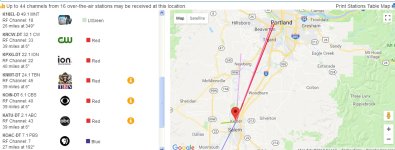
I have a question James, I get pretty good reception off a $25 craigslist TV antenna (looks like a 4 element Channel Master type), but I occasionally have difficulty with channel 2 and it's sidebands. They all come from "tower mountain" in Portland. Sometimes it perfect, sometimes it's so pixellated and distorted the image jams (at least with the old analog you could hear the Jeopardy questions through the snow) and becomes unwatchable.
Could that particular band be more susceptible to atmospherics, as other signals from the same area are unaffected?
AntennaWeb.jpg
 
/ Updated TV Antenna Thoughts #90  
I have a question James, I get pretty good reception off a $25 craigslist TV antenna (looks like a 4 element Channel Master type), but I occasionally have difficulty with channel 2 and it's sidebands. They all come from "tower mountain" in Portland. Sometimes it perfect, sometimes it's so pixellated and distorted the image jams (at least with the old analog you could hear the Jeopardy questions through the snow) and becomes unwatchable.
Could that particular band be more susceptible to atmospherics, as other signals from the same area are unaffected?
View attachment 540866

Are you talking about KATU-DT the ABC affiliate? as shown on the sidebar of your map? There are not very many stations actually on RF channel 2 any more, KATU-DT is on actual RF channel 43, so it is in the UHF spectrum. My first thought is that the fade margin for this station at your location is near non-existent. In other words the signal can fade (for a number of reasons) but the margin of excess signal that you have at your location is very low or none. So when a fade happens, say from tropospeheric bending or rain or snow you have no margin to make up the slight dip in signal, so you have digital drop out.

A signal strength analyzer measurement on a good day, then measure when you have drop out that would tell the tale.

Amazon.com: Solid Signal Digiair Pro ATSC TV Antenna Signal Meter Spectrum Analyzer (DIGIAIR-PRO-ATSC): Electronics
 
/ Updated TV Antenna Thoughts #91  
Yes, it is KATU. Other stations that run on the RF 8 and 12 bands are in the light green area above the chart, despite being in the same distance and aiming range, so the higher RF must be the factor. I see that it is part of the FCC repack, and will be going from 43 to 24, so I'll see if that makes any difference.
Much as I'd like that whizz-bang toy, not spending that kind of money; one of the reasons for going to antenna was to eliminate the cable$$. Plus they required a box, thus rendering the dvd recorders with digital tuners unusable on their platform. Thanks for the info.
 
/ Updated TV Antenna Thoughts #92  
The installation instructions say the power supply can go anywhere from a few feet to 150' away from the amp. It doesn't affect anything.


Amplifier is supposed to be mounted up on the antenna and the power supply down near the TV. Having the amp up at the antenna amplifys more signal and less noise .
 
/ Updated TV Antenna Thoughts #93  
We use a Winegard Flat Wave FL-6550A . My daughter would not allow 殿 big ugly deep fringe Yagi? It is small , unobtrusive, amplified and with low loss RG-6 cable . For being mounted too low on the eve of a bungalow house with hundreds of houses and trees obscuring the signal from Detroit to Sarnia . The almost invisible Winegard Flat Wave FL-6540A reliably brings in 3 channels of NBC , 3 channels of ABC, 4 channels of PBS, 2 channels of CBS and from Ontario CTV2, CHCH and CIII Global.
For all it cost , the 60 mile distance from transmitters and the too low/obscured antenna mounting . It does very well.
 
Last edited:
/ Updated TV Antenna Thoughts #94  
Amplifier is supposed to be mounted up on the antenna and the power supply down near the TV. Having the amp up at the antenna amplifys more signal and less noise .

Again, read the manufacturers instructions. Yes, you are correct that's the amp is supposed to be mounted close to the antenna. No, you are incorrect that the power supply has to be near the TV. It does not.
 
/ Updated TV Antenna Thoughts #95  
See if you had some specifications of gain in the forward lobe of your antenna, then you could take a measurement of your received signal strength, and calculate your "fade margin". This is always done in commercial installations of point to point systems. You must know your fade margin to know if a particular antenna with a particular gain is going to get the job done when conditions are not so good as your reference test. Rain and snow will attenuate your signals, but if you knew you were on the "ragged edge" or had say a 10 dB fade margin or not could help guide your choices.

Of course you can make estimates all day, and say, well, bigger is better etc. And that is true but if you KNEW what you had you could spend your money wisely. There is actual science to antennas, transmission lines (coax) and path loss. We can make actual calculations with just a LITTLE knowledge. I could teach many of you the concepts of antenna gain (never something for nothing, antennas with gain in one direction have loss in another), transmission line losses, and how the decibel scale works. in about a day. But with no specifications printed out that we can work with, we would have to do our own experiments to find these things out. So I guess we will just look at "miles" ratings and go on with life. :) Enough of my rant. But if any of you would like to learn something about antennas or related things, I will do my best to answer them. I don't have all the answers, but I can usually find them. :D

I understand how antennas work. I have two degrees in electronics (industrial electronics, and communications, with a focus on TV and radio repair). I just don't like the advertising hype of internet TV antenna sellers. It does nothing for the average homeowner, but make them think "bigger numbers mean it must be what I need."

I have no test gear, that's my problem. :rolleyes:
 
/ Updated TV Antenna Thoughts #96  
I understand how antennas work. I have two degrees in electronics (industrial electronics, and communications, with a focus on TV and radio repair). I just don't like the advertising hype of internet TV antenna sellers. It does nothing for the average homeowner, but make them think "bigger numbers mean it must be what I need."

I have no test gear, that's my problem. :rolleyes:

Yeah, test gear gets expensive. AND you don't need it all the time. Of course when I worked in TV shops (back in the day) we had access to everything I needed. That was nice , but those days are long gone. I went to the telephone industry and into application engineering. Now antenna work and RF is all just hobby to me now. I bet we would have fun together, I could teach you some RF things and you could teach me more networking. Shame you live so far away. If you ever have a hankering into getting your Amateur radio license and working on some of the new digital techniques that we use, I sure would help you get started. I have helped dozens of guys over the phone and using Teamviewer.
 
/ Updated TV Antenna Thoughts #97  
^^^ Growing up in the 60's we had a neighbor in a residential neighborhood with a tower... he was a long haul truck driver for a time.

He would be on the radio Saturday mornings... we could hear everything he said as it came through the Blaupunkt Stereo the folks had and we were not the only ones.

Another neighbor just had a Genie Door Picker-Upper installed... when the radio guy Key Up the mike the door would open or close...

As kids we were amazed... some of the drown ups not so much.

Later we moved next to the Navy Hospital... the church had PA system and the Medivac Helicopters would come through crystal clear sometimes...

I only got as far as CB... my Radio Shack Antenna is still on the roof of the house where I grew up... my radio was all chrome and had tubes... good memories.... collected a lot of cards from far off places back then.
 
/ Updated TV Antenna Thoughts #98  
My youngest daughter's boyfriend has his ham license.... there's hope for the younger gen, yet! :laughing:
 
/ Updated TV Antenna Thoughts #99  
I understand how antennas work. I have two degrees in electronics (industrial electronics, and communications, with a focus on TV and radio repair). I just don't like the advertising hype of internet TV antenna sellers. It does nothing for the average homeowner, but make them think "bigger numbers mean it must be what I need."

I have no test gear, that's my problem. :rolleyes:
Yea, i work in a whole building full of rf engineers that design antenna systems all day long. Fcc certified lab. Guess i can ask one of them, or go back and restudy my EE books on the subject. I did not like that section of EE. I only been at this job a few months, i do software testing on rf devices. Another whole section tests the rf stuff, including my new officemate. He's out with the flu.


But this is a darn tv antenna, pick one from a stack of 100, most will do the job right now, until they repack some of the high uhf into low vhf space.

Mine broke. I could easily fix the broken one, but wanted a smaller antenna for todays freqs. I could also remove the low v section of the one on my deck and put it up the pole.
 
/ Updated TV Antenna Thoughts #100  
My company is hiring RF engineers.
 
 
Top