Mud on Battery issues

/ Mud on Battery issues #1  

EddieWalker

Epic Contributor
Joined
May 26, 2003
Messages
27,920
Location
Tyler, Texas
Tractor
Several, all used and abused.
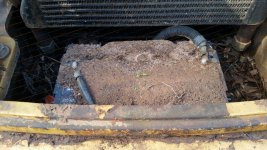
I think the battery on my backhoe is just a few years old, but I can't say for sure. Time flies by too fast to remember for sure. It's been working great and the engine usually fires up right away. The last two times I started it, it was slow and took quite awhile until it caught and fired up. Today it wouldn't start at all. The easiest way to get the battery cable to it is to take off the front screen. The battery is right behind it, in front of the radiator.

This is what I saw.
12308707_10208354305917947_180337358957583349_n.jpg


The dirt is a quarter inch thick and moist. I never thought about dirt on a battery causing any problems, but if it's wet, could that cause the battery to drain or not hold a charge? We've also just started to get some colder temps down into the 30's. It might just be the cooler temps and an older battery, that needs to be replaced, but I am curious if the wet dirt might have caused it, or been a part of the battery not holding a charge like it used to.
 
/ Mud on Battery issues #3  
Wet mud will certainly conduct electricity. Could drain or fry the battery. What plant is growing there?
I would clean it up, charge it an load test it since cold weather is near by. This way you will know if the battery is going to get you through the winter.
 
/ Mud on Battery issues #4  
I'd say yes, at least with AC for sure.
Water does conduct so mud would also, with the acidity levels determining the rate.
 
/ Mud on Battery issues #5  
I always love it when you guys in the more temperate climes say its cold it when its +30F :D
 
/ Mud on Battery issues #7  
Eddie, I believe that much mud would likely cause quite a drain on the battery. Yeah I would clean that up!

I have never seen a battery top that dirty!
 
/ Mud on Battery issues
  • Thread Starter
#8  
Thanks. I'm thinking I might need to invest in a cover for the top of the battery. Being in the front like this, the dust never ends coming off of the loader. Especially when hauling debris with the grapple all day long, day after day.

This is just one of those things I never even thought about. Turn the key, it starts, so why check how clean the top of the battery is?
 
/ Mud on Battery issues #9  
Thanks. I'm thinking I might need to invest in a cover for the top of the battery. Being in the front like this, the dust never ends coming off of the loader. Especially when hauling debris with the grapple all day long, day after day.

This is just one of those things I never even thought about. Turn the key, it starts, so why check how clean the top of the battery is?

I think a rubbermaid container turned upside down over the battery would go a long way keeping things a bit cleaner.
 
/ Mud on Battery issues #10  
Thanks for making feel better about my battery maintenance or lack thereof.
I infrequently check my no-maintenance batteries and find the acid level low because they are no maintenance right?
We have all gotten sloppy with battery care compared to 40 years ago and we should not be.
Thanks for the reminder
 
/ Mud on Battery issues #12  
The reason outlets near sinks have ground fault interrupters on them is because water conducts electricity to ground. Similar thing with water in dirt between battery terminals.
 
/ Mud on Battery issues #13  
Thanks for making feel better about my battery maintenance or lack thereof.
I infrequently check my no-maintenance batteries and find the acid level low because they are no maintenance right?
We have all gotten sloppy with battery care compared to 40 years ago and we should not be.
Thanks for the reminder

That is why there really is no such thing as a maintenance free battery. Charging breaks down the water and produces H2 and O2. (why there is that warning about charging batteries). You don't lose the acid just the water, so add distilled water to maintenance free batteries and they will last even longer.

EM1(SS) Retired
 
/ Mud on Battery issues #14  
...This looks like a good deal!!!

Looks like a really good deal.Thanks for pointing it out.

I just ordered one to hold a spare battery for my emergency generator.

The battery is going to sit on a concrete floor, and the advice is always to never put a battery on a concrete floor. For less than $9 the problem is solved.
 
/ Mud on Battery issues #15  
I always love it when you guys in the more temperate climes say its cold it when its +30F :D

Ha! I love it when you guys up north call 80 degrees with 30% humidity hot! :D

It ain't hot until it it's at least 90 deg + with 70 % humidity and sweat is just dripping...:laughing:
 
/ Mud on Battery issues #16  
Even when it's 90, a good shade tree feels like air conditioning when I'm mowing down front. I laugh when I hear the guys talk about cabs and heaters. I want a cab but it's not for winter. I want AC if I can find a place to mount the compressor. When we want more heat in winter down here, we open a door. :)
 
/ Mud on Battery issues #17  
Looks like a really good deal.Thanks for pointing it out.

I just ordered one to hold a spare battery for my emergency generator.

The battery is going to sit on a concrete floor, and the advice is always to never put a battery on a concrete floor. For less than $9 the problem is solved.

Sorry, the myth of not putting a battery on a concrete floor is just that. The battery case is plastic, and so is the battery box you're buying. Batteries do NOT lose charge through the case to the concrete floor/ground.
When I had my foreign auto shop I sold Interstate batteries for many years.
 
/ Mud on Battery issues #18  
From homepower.com, concrete floors are a good place to store a modern battery:

--------
However, this legend is historically based in fact. The first lead-acid batteries consisted of glass cells that were enclosed in tar-lined wooden boxes. A damp concrete floor could cause the wood to swell, breaking the glass inside.

The Edison cell (i.e. the nickel-iron battery) that preceded the rubber-cased battery was encased in steel. Those that weren't isolated in crates would discharge into concrete quite easily. Later battery cases used primitive hardened rubber, which was somewhat porous and could contain lots of carbon. A moist concrete floor combined with the carbon in the battery cases could create electrical current between the cells, discharging them.

None of this is a problem with modern batteries — safe in their hard plastic shells. In fact, concrete is generally an excellent surface on which to place a battery bank. The electrolyte in a battery sitting on an extremely cold floor with very hot air around it could stratify, causing damage from sulfation; whereas concrete provides good thermal mass to buffer any temporarily extreme temperatures in the battery compartment.
--------
 
/ Mud on Battery issues #19  
From homepower.com, concrete floors are a good place to store a modern battery:

--------
However, this legend is historically based in fact. The first lead-acid batteries consisted of glass cells that were enclosed in tar-lined wooden boxes. A damp concrete floor could cause the wood to swell, breaking the glass inside.

The Edison cell (i.e. the nickel-iron battery) that preceded the rubber-cased battery was encased in steel. Those that weren't isolated in crates would discharge into concrete quite easily. Later battery cases used primitive hardened rubber, which was somewhat porous and could contain lots of carbon. A moist concrete floor combined with the carbon in the battery cases could create electrical current between the cells, discharging them.

None of this is a problem with modern batteries — safe in their hard plastic shells. In fact, concrete is generally an excellent surface on which to place a battery bank. The electrolyte in a battery sitting on an extremely cold floor with very hot air around it could stratify, causing damage from sulfation; whereas concrete provides good thermal mass to buffer any temporarily extreme temperatures in the battery compartment.
--------

Should have said, ever since history began it was true, then came plastics, and everything changed. So since about the 20th century, roughly, and the invention of plastics, the world of batteries changed.

Plastic cases don't allow discharge of the battery through a concrete floor.
 
/ Mud on Battery issues #20  
That is why there really is no such thing as a maintenance free battery. Charging breaks down the water and produces H2 and O2. (why there is that warning about charging batteries). You don't lose the acid just the water, so add distilled water to maintenance free batteries and they will last even longer.

EM1(SS) Retired
I guess you don't know about AGM (Absorbed Glass Mat) batteries. I have been using them for many years.

AGM Battery | AGM Battery Charging | OPTIMABATTERIES
 
 
Top