
vtsnowedin
Elite Member
When it comes to taking apart old rusted nuts and bolts we call cutting torches the red and green wrench.
Some years ago, i was helping an "old timer", <--my current age now, tunnel into an old portion of a mine. We were using pick axes to cut through that the last few feet and it opened into a largish room that still had a bunch of the old equipment laying about. Some of it was those carbide miners lanterns. They cleaned up well and were functional. Very bright!I remember my dad using his blow torch occasionally, but I don't remember what for! Not frozen pipes (in So. Cal.). Have any of you older members ever lit an old-fashioned carbide miner's lantern? Now that was a real GAS for a pre-teen!
BOB

Perhaps the cop was using speedloaders where the six rounds are indeed held in a clip.
Duty Gear | Speedloaders | Speedloader Holders - Safariland™

I remember my dad using his blow torch occasionally, but I don't remember what for! Not frozen pipes (in So. Cal.). Have any of you older members ever lit an old-fashioned carbide miner's lantern? Now that was a real GAS for a pre-teen!
BOB

I have seen people put a bunch of carbide in a can with some rocks in the can to make it sink, add water to generate the gas then pound on the lid. I guess it auto-ignites from the heat and pressure, because it makes a pretty good boom underwater.Nope, no personal experience with those lanterns, but when I was about 3 until I was 10 years old, my Dad drove a truck calling on mechanics, blacksmiths, etc. selling welding supplies, including cans (maybe 25 pounds) of carbide. Now I assume you've seen what will happen if you dump a tablespoonful of carbide in a coffee can of water. For those unfamiliar with carbide, it makes the water boil, and if you're quick, you can light it and have a flame above that water. At one time, a can got spilled on the ground and I gathered up what I could. Dad told me to never put more than one tablespoonful of carbide in the water at a time, but the reaction is very, very short lived. So one day, I quickly scooped at least 3 or 4 tablespoonsful into the water and struck a match. Fortunately, the only damage from that little explosion was that my right hand felt like it was on fire most the day, and I sure couldn't tell anyone or let them see my red hand because if Dad had found out, he'd have done more damage to my rear end than the carbide did to my hand.
muddstopper said:My dad used to have a cutting torch that used pump gas to cut with. Tank probably held about a gallon of gasoline. It had a pump, similar to the old coleman gas lanterns we used to take camping. The pump was to pressurize the gas so it would flow thru the hoses to the torch body. It used a regular oxy tank and regulator. Dont know what ever happened to the torch. Dont miss it, but wouldnt mine having it back just for a conversation piece.
I have seen people put a bunch of carbide in a can with some rocks in the can to make it sink, add water to generate the gas then pound on the lid. I guess it auto-ignites from the heat and pressure, because it makes a pretty good boom underwater.

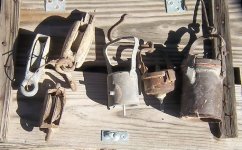
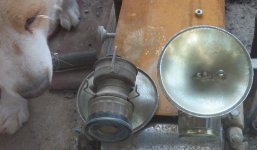
A typical, old-fashioned carbide miner's lamp has a lower compartment for carbide (CaC2) and an upper one for water. A valve controls water drip into the carbide where a chemical reaction produces acetylene gas which comes out a small nozzle in the middle of the reflector. There is a flint striker wheel near the edge of the reflector (just like a cigarette lighter flint wheel). Once you start the water dripping into the carbide, you hold your hand over the open end of the reflector to allow gas to accumulate, then quickly sweep your hand to the side across the flint wheel. The resulting spark ignites the acetylene gas with a pronounced POP! Since gas is being produced continously, there will be a flame in at the nozzle in the middle of the reflector; the size of the flame can be adjusted by tweaking the water drip rate. Carbide lamp - Wikipedia, the free encyclopedia
By the way carbide in carbide saw blades and other cutting tools is tungsten carbide (WC) which, like corundum (Al2O3; rubies and sapphires!), is 9 on the Mos scale of hardness (where diamond is 10); unlike CaC2, WC doesn't react to water by producing acetylene gas!
BOB
 -
- 
My dad had two blowtorches that he used to heat the glow plug on a single cylinder diesel engine. The engine drove a water pump thru a long flat belt. The engine was high up on the river bank and the pump was down next to the normal water level. The blowtorch would heat the glow plug to cherry red, then he would start to spin the flywheel by standing on a spoke. He had two blowtorches because sometimes it took more than one fuel fill of the torch to get the plug hot enough. Once the engine was running it would blow smoke rings out the exhaust.
That was back in the 1940's before we got electricity. I now have one of the blowtorches on the shelf in my office. My son has the other one.

